Blog
Bigger on the Outside: What Vendors Can Do with the Compute Node I/O Shield
Introduction
OpenSFF is a nonprofit organization developing open-source hardware specifications for compact compute systems. Our eponymous standard defines three components: a processing module called the Compute Node, an active electronic housing called the Enclosure, and an optional node management component called the Management Module. These three components can be combined to create a variety of systems, from multi-node servers to single-node edge devices. Any Compute Node will work with any Enclosure, regardless of their vendors. The same goes for the Management Module and compatible Enclosures.
When discussing the Compute Node’s flexibility or our standard’s interoperability, we often point out that the Enclosure largely defines an OpenSFF-compatible system’s purpose. Networking, cooling, power delivery, and management are all tied to the Enclosure, and we do not limit its form factor or layout. An Enclosure can be anything from a typical rack-mounted server to a weatherproof router.
But vendors can also differentiate their Compute Nodes by offering additional I/O beyond the minimum required signals that we defined. We touched on this in our connectivity options article, but today we’d like to take a closer look at the opportunities that vendors have with the node’s rear I/O shield.
What the Compute Node Specification says
Space
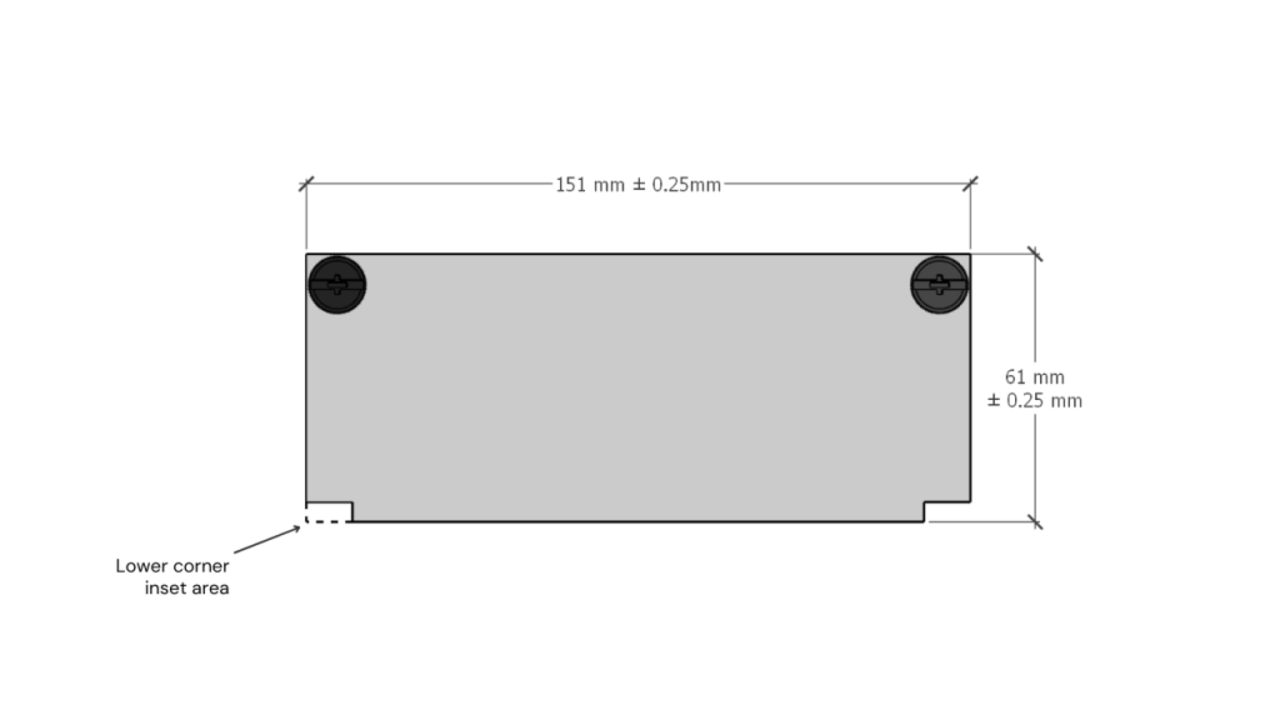
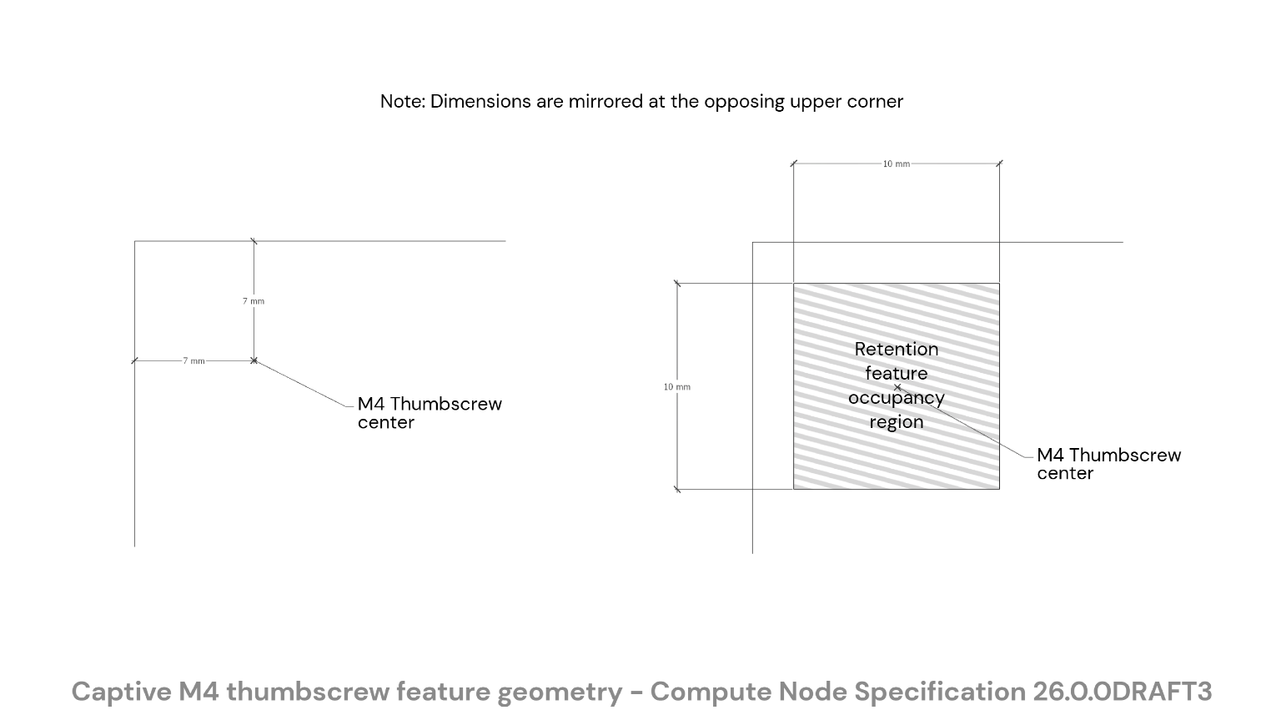
The rear I/O shield is 151mm wide and 61mm tall, and can be between 0.8mm and 2.0mm thick. Its lower corners are inset to accommodate features that retain the shield to the PCB. Meanwhile, the shield’s upper corners must be left untouched, as those are where the captive M4 thumbscrews are located.
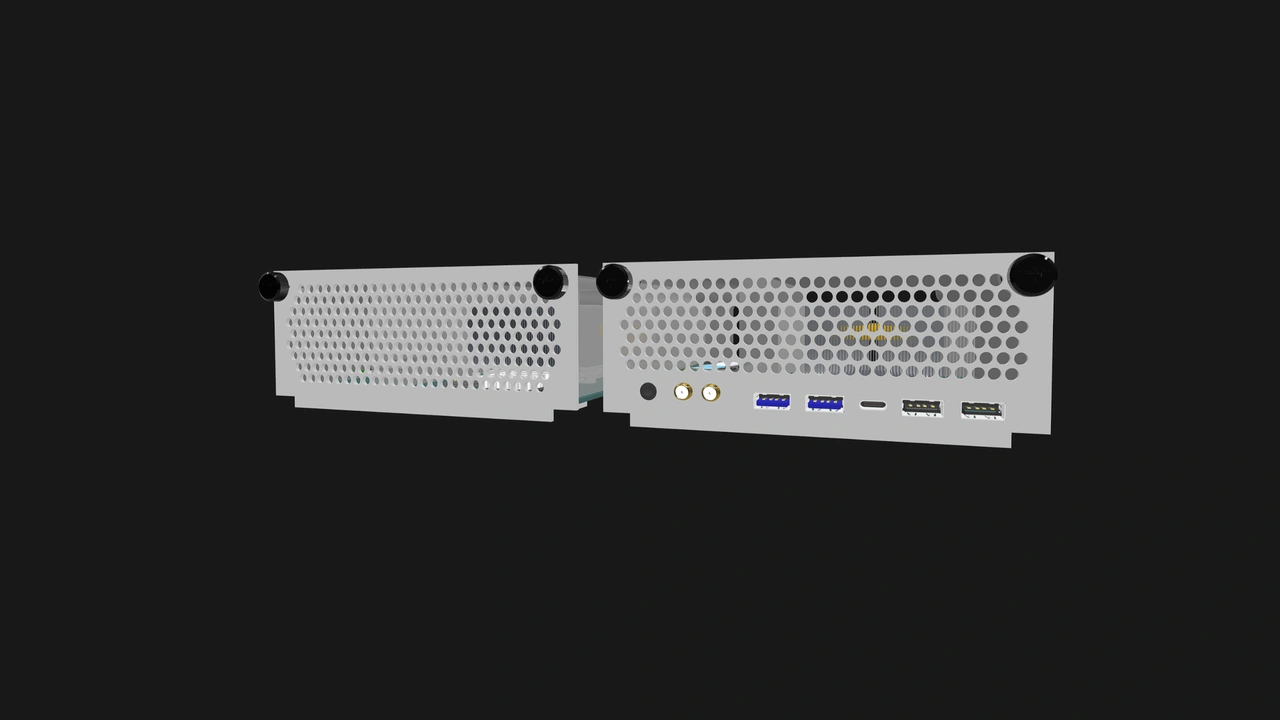
Despite these constraints, the rear I/O shield has enough space for a row of double-tall connectors or up to three rows of regular-sized connectors.
Cooling
Besides the physical space on the rear I/O shield, vendors must also account for their Compute Node’s airflow. Air is exhausted through the rear I/O shield’s perforations. While we do not prescribe a minimum perforation density for the shield, vendors do have to ensure that their node’s components are adequately cooled during sustained operation.
Because Compute Nodes must work with any Enclosure regardless of the latter’s active cooling potential, vendors cannot simply fill a node’s rear I/O shield with ports even if their selection technically fits within the available space.
The 120W Compute Node Maximum Power Target
Each Compute Node slot in an Enclosure delivers up to 120W of sustained power. While most I/O options consume only a fraction of that power, vendors do need to consider outliers such as Ethernet ports that support Power over Ethernet (PoE). A Compute Node may have enough space and signals for eight PoE ports, but those would take up most of the node’s power budget.
With these considerations in mind, let us go over several port selections that are physically and electrically feasible on the Compute Node’s rear I/O shield.
Sample Compute Node rear I/O shield additions
Router/firewall ports
Eight Ethernet ports and a single SFP+ uplink would turn a Compute Node into a dedicated network appliance. It would provide sufficient interfaces to separate WAN, LAN, and several VLANs without requiring a discrete network switch. This node would be great for homelabbers or small businesses running open-source router software such as OPNsense or pfSense. They would have the freedom to choose a single- or multi-node Enclosure, as well as the option to source the node or its eventual replacement from a different vendor.
Industrial/serial ports
The rear I/O shield has enough space for up to 10 DB9 ports arranged in three rows: two ports on the top row and four ports each in the middle and bottom rows. This array of ports would make for a Compute Node that is highly suited for industrial or lab deployments.
Hot-swap storage bays
An EDSFF E.1S drive bay is roughly 34mm wide, which means the rear I/O shield has enough space to fit four bays. This of course assumes that the node’s processor has enough PCIe lanes for all the bays plus any other interfaces routed through the connection. A more consumer or homelab-oriented node could have two 2.5” SATA drive bays.
AV ports
Vendors have several options here. They can tune their implementation for either purely video or audio workloads, or simply provide additional I/O to process a combination of the two. For instance, a kiosk or digital signage appliance could benefit from a node with a DisplayPort or HDMI output along with an IR receiver, in addition to the required DisplayPort signal that is routed through the Core Connector.
A node with an integrated video capture card could expose the card’s DisplayPort or HDMI input on the rear I/O shield, while an audio interface node could have analog audio, microphone, and optical S/PDIF ports. Each of these ports take up little space and consume small amounts of power, making them easy to combine or utilize to make specialized nodes.
PoE ports
Similar to the router port concept, a node with PoE ports could eliminate the need for an external PoE-capable network switch. Four 802.3af ports, each capable of carrying about 15W, can power basic IP cameras, wireless access points, and other devices. That would leave another 60W for the rest of the node.
Build with OpenSFF
The rear I/O shield is just one of the many ways that our standard presents a floor instead of a ceiling. The Compute Node Specification allows vendors to make significant product decisions to differentiate or innovate beyond simply adding extra USB ports.
This may be particularly significant for vendors who wish to ship complete OpenSFF-compatible systems. They can organize and segregate their system’s I/O and make their node perfect complements to their Enclosure while retaining interoperability with OpenSFF-compatible components from other vendors.
We encourage you to read our specifications, and we would be grateful if you spread the word about OpenSFF. For technical clarifications, partnerships, and other inquiries, reach out to our development team at [email protected].
Other Articles

Meet OpenSFF: an open hardware standard that enables cross-vendor compatibility, modular systems, and sustainable hardware reuse.
August 11, 2025
We go over the rise of virtualization and the open software adopted by home server enthusiasts, as well as the current challenges and the future of the hobby.
September 06, 2025

Learn why OpenSFF adopted the SFF-TA-1002 connector standard and how it enables our vision.
September 18, 2025