Blog
Durable Goods: How OpenSFF Can Lead to IIoT Hardware That Goes the Distance
Introduction
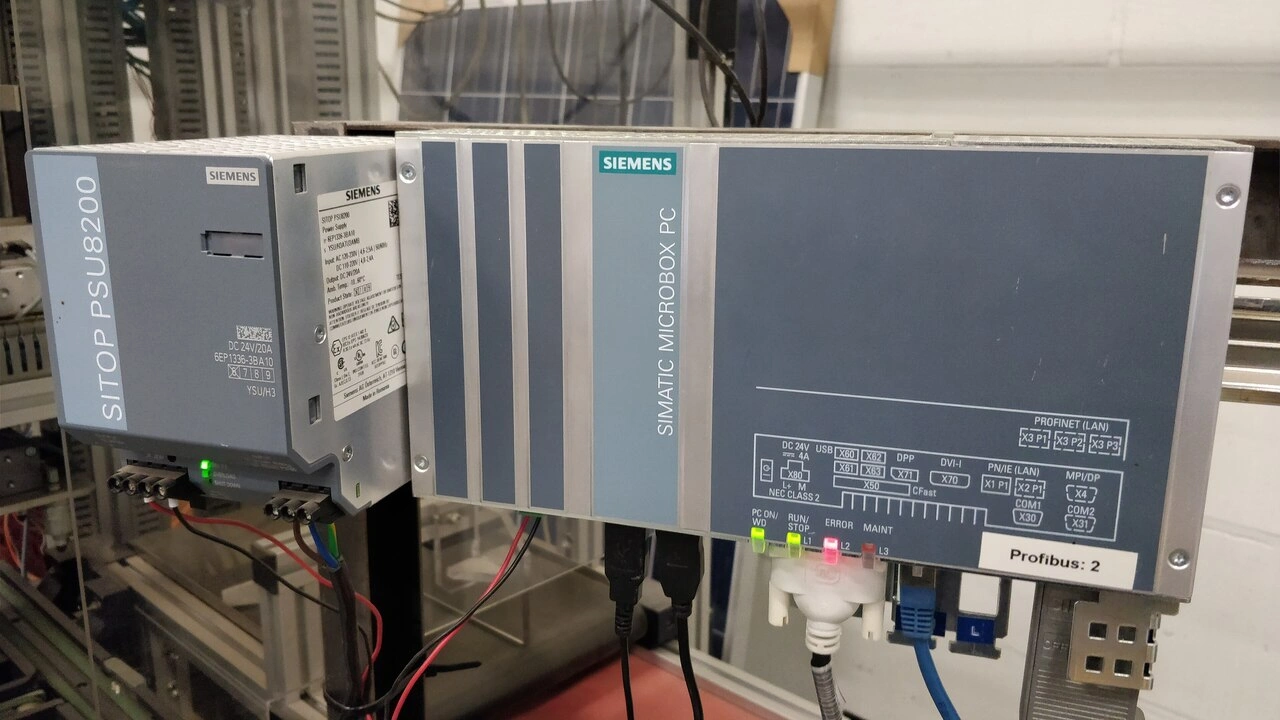
Industrial IoT (IIoT) deployments are built to run for a decade or longer, in line with the service life of the machinery that they support. But the computers that power them frequently tell a different story. Gateways, edge servers, ruggedized PCs, and other industrial computers typically come with support windows that expire before the deployment does, and customers have no control over when a product line will be discontinued.
While proprietary designs and management systems can result in space-optimized form factors and convenient integration, they can also hamper serviceability. When hardware inevitably fails, having a replacement unit on hand does not guarantee a quick turnaround.
OpenSFF is developing open specifications for modular, serviceable, and highly adaptable small form factor compute systems. In this article, we are going to go over three ways that the current hardware landscape creates long-term challenges for IIoT teams, and how our standard is designed to address them.
Hardware failures are costly and difficult to rectify
ABB’s 2023 survey report on industrial maintenance and reliability put the median cost of unplanned or unscheduled downtime at $125,000 per hour. A 2024 Siemens report on the same topic found that unplanned outages cost enterprise manufacturers 11% of revenues on average. But when a gateway or aggregation system goes down, recovery can be slower than it needs to be. A number of factors compound to extend downtime and delivery delays.
Long manufacturing cycles, legacy systems, and inconsistencies with local supply and logistics can lead to extended wait times for industrial hardware. But even when a facility has a replacement unit on hand, getting back online often involves more than a physical swap. Manual reconfiguration and vendor-specific tooling can add hours of downtime that a well-stocked inventory cannot address.
The availability of skilled technicians can be another factor. A 2024 Deloitte report on the growth of US manufacturing estimates that there will be nearly 2 million unfilled manufacturing jobs in the country by 2033, including industrial machinery maintenance roles. Emergency repairs that require vendor-specific expertise can extend outages, yet these scenarios are hard to quantify at procurement.
OpenSFF makes it easier to recover from hardware failures
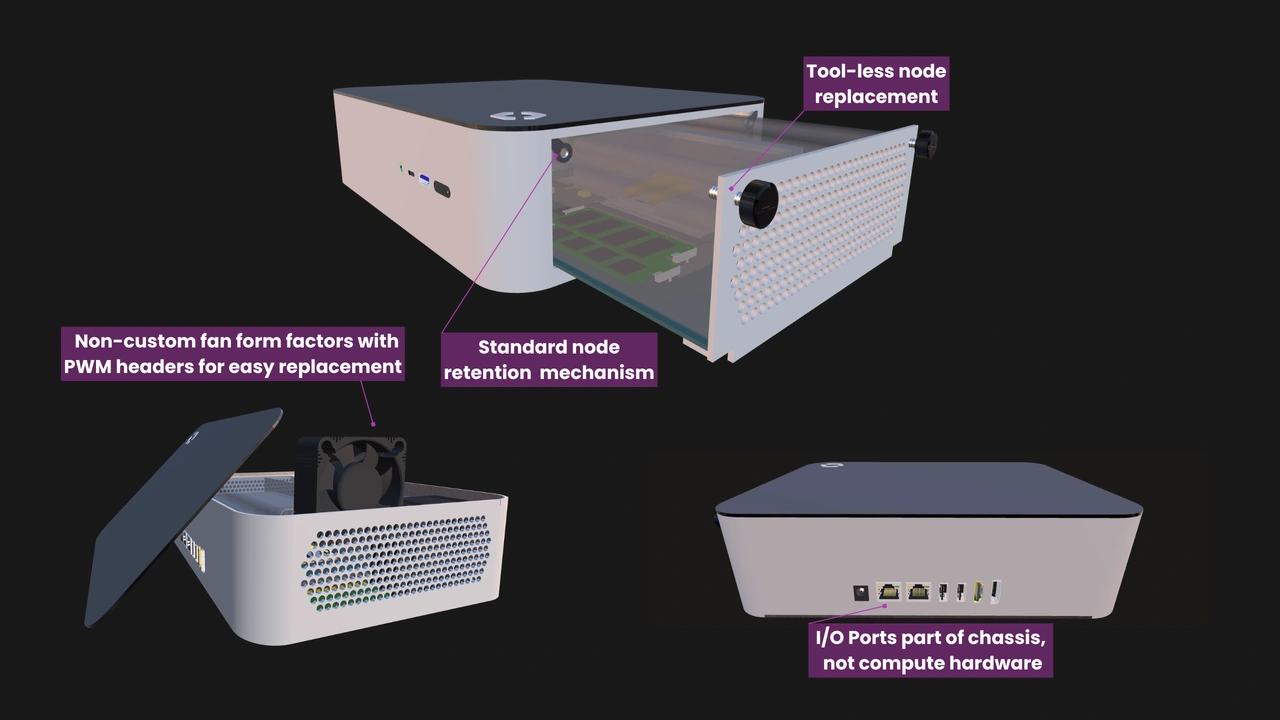
Our standard enhances serviceability at the mechanical level. Compute Nodes mount to Enclosures using only a pair of captive M4 thumbscrews. Enclosure slots also have blind-mate card edge connectors and guide rails. Even general on-site staff can replace nodes without vendor support or specialized tools.
Power, data, and management signals all route through the modules’ SFF-TA-1002 4C+ connector rather than discrete internal cables, reducing wiring complexity and the number of parts that can fail due to wear and tear.
Because Compute Nodes share the same form factor and connector interface, customers do not have to rely on a single vendor and can avoid being locked in. This introduces flexibility both at procurement and in long-term operations. It may also be possible for a facility to stock replacement nodes that are suited to more than one type of device.
Proprietary systems trade convenience for longevity and resilience
Proprietary edge hardware can have highly optimized form factors, tightly integrated software, and a single point of contact for support. On the other hand, companies can be forced to replace or upgrade these devices even when they are still completely functional.
Moxa’s gateway brochure notes that the average warranty for industrial computers is only 2 years. Moxa itself has a 5-year warranty on its ARM-based products. Advantech has the same warranty period, along with a 7-year product supply guarantee. But when we consider that industrial machines can run for a decade or longer, the mismatch becomes clear.
The product lifecycle problem extends beyond warranties. When a vendor discontinues a product line, they forcefully trigger transitions that may involve re-validating workflows, retraining staff, and discarding hardware that is still perfectly functional.
The industry is clearly aware of the problem. The Linux Foundation’s Margo initiative launched in 2024, with support from major players such as ABB, Siemens, and Microsoft. Margo addresses the fragmentation and vendor lock-in at the software and orchestration layer. It seeks to standardize how containerized applications are defined, deployed, and managed across edge hardware. OPC applies a similar approach at the protocol layer. EVE-OS, another Linux Foundation project, aims to provide a vendor-neutral operating system for edge devices.
OpenSFF standardizes the foundation
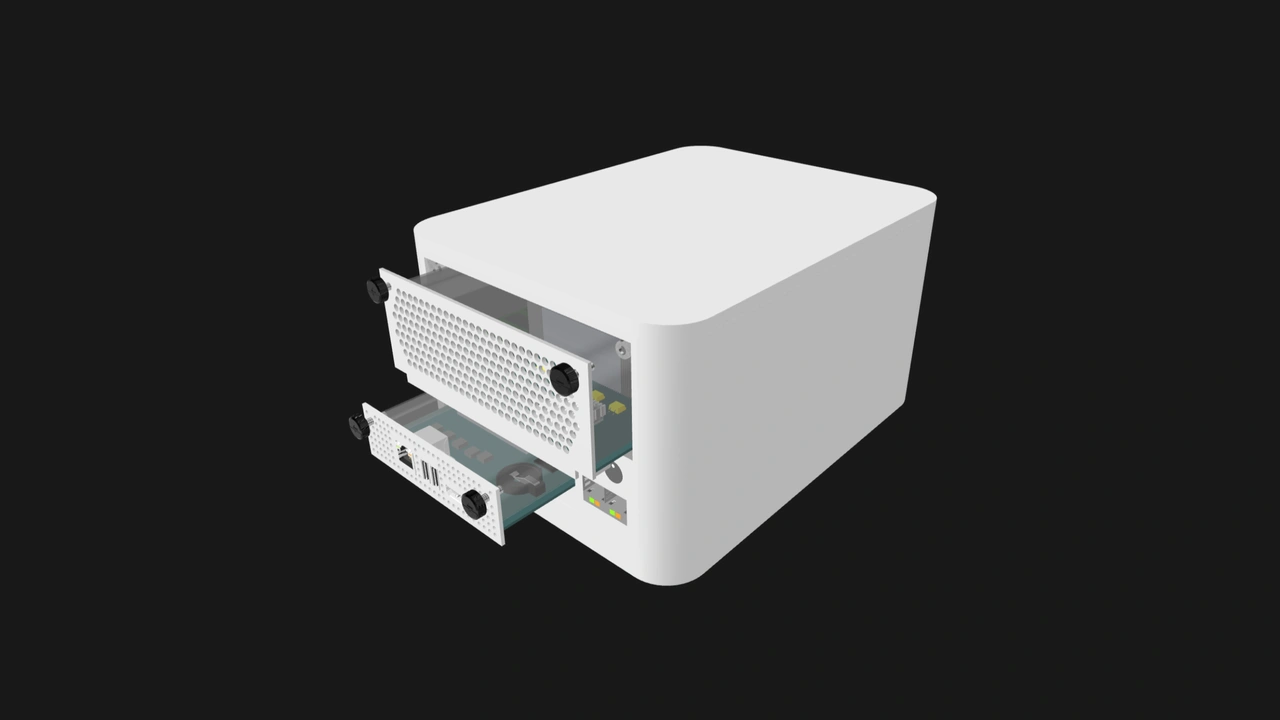
Our standard is a great complement to ongoing efforts that seek to provide interoperability within industrial edge hardware. Compute Nodes, Management Modules, and Enclosures are vendor-agnostic, and could remain compatible across generations. Compute Nodes and Management Modules can be replaced without touching the Enclosure or its physical installation, drastically reducing downtime.
An open hardware standard is the perfect foundation for interoperable software and protocols. It would be more efficient to validate those on a standard instead of on hundreds of proprietary configurations. Ultimately, OpenSFF can enable customers to service nodes on their own timelines, and rely on familiar installation and maintenance procedures.
IIoT device management is fragmented
Managing distributed devices is already a difficult operation on its own. While many industrial edge devices can be supported by robust software suites that cover device management, those platforms often work only within their vendor’s ecosystem. Moxa Industrial Linux, Axiomtek Agent MaaS Suite, Lenovo XClarity… the list goes on. A multi-vendor deployment means a customer has to learn and secure multiple management workflows and credentials.
OpenSFF’s Management Module liberates device management
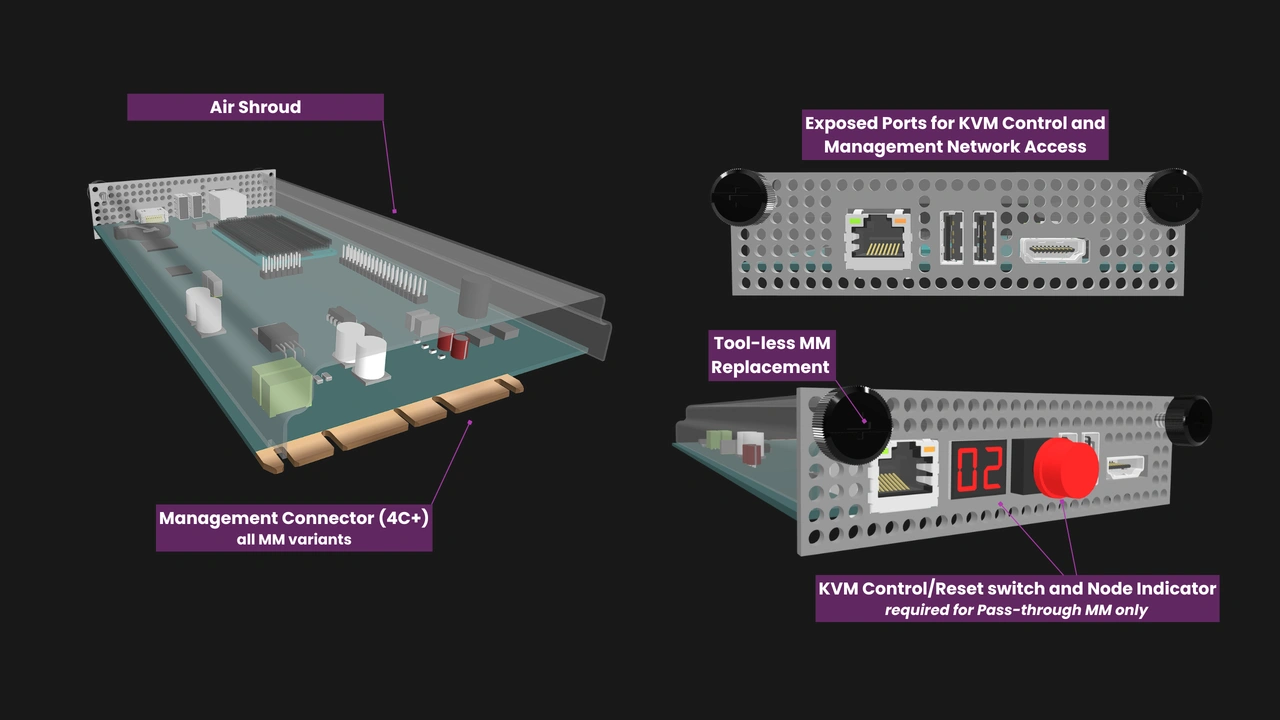
The Management Module (MM) is a user-replaceable device that has a dedicated slot in compatible Enclosures. It provides KVM functionality and power control to all installed Compute Nodes through the Private Enclosure Network (PEN). The PEN is an internal out-of-band Ethernet fabric in compatible Enclosures that connects nodes to the MM regardless of the nodes’ vendor or operating system.
The MM architecture is designed to support both simple local-access deployments and more advanced remote management systems, as demonstrated by the reference designs in the MM Specification. The Pass-through MM is a passive hardware device with no embedded processor. It routes management signals directly to its external ports for local access in simple or air-gapped environments. The Full-featured MM runs a custom version of Raspberry Pi OS and supports IP-KVM, node telemetry, and remote OS installation. Just like Compute Nodes, any MM will work with any node or compatible Enclosure, regardless of their vendors. With an OpenSFF system, customers would not have to depend on any single vendor’s management stack, and the MM can be replaced independently of the nodes it manages.
Build with OpenSFF
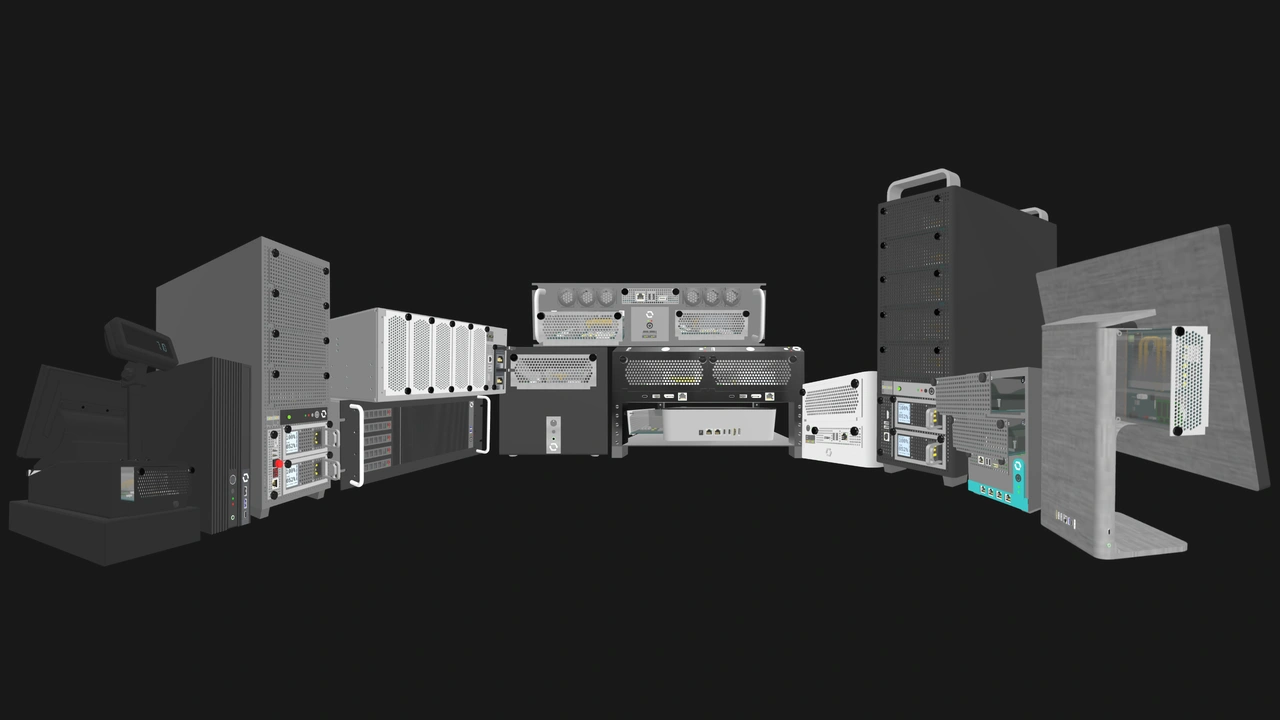
Industrial and manufacturing machines need supporting devices that can last as long as they do. Edge hardware that can be sourced, serviced, and managed without a support window or product roadmap running down the clock. The industry is already moving towards interoperability, and our hardware standard can strengthen and accelerate these projects.
Besides being open-source, our standard’s flexibility also encourages new vendors to enter the IIoT space. Compute Nodes can control a wide range of devices, and Enclosures can take on any form: a gateway, an HMI computer, an aggregation system, and much more. OpenSFF lowers the barrier to entry and allows vendors to specialize on components and their features instead of designing complete systems from scratch. More competition means more customer options and longer-lasting deployments.
We encourage you to read our specifications, and we would be grateful if you spread the word about OpenSFF. For technical clarifications, partnerships, and other inquiries, reach out to our development team at [email protected].
Other Articles

Meet OpenSFF: an open hardware standard that enables cross-vendor compatibility, modular systems, and sustainable hardware reuse.
August 11, 2025
We go over the rise of virtualization and the open software adopted by home server enthusiasts, as well as the current challenges and the future of the hobby.
September 06, 2025

Learn why OpenSFF adopted the SFF-TA-1002 connector standard and how it enables our vision.
September 18, 2025