Blog
The OpenSFF Glossary
Introduction
Like any technical standard, OpenSFF comes with precise vocabulary. Understanding the definition and proper usage of these terms not only creates clarity. We also aim to underscore why we created some of these terms instead of adopting existing ones that may seem equivalent at first glance.
The Enclosure
An OpenSFF system starts with its Enclosure. It defines what the system can hold, how it is cooled, what infrastructure it provides to the rest of the hardware, and ultimately, its viable use cases and deployment environments.
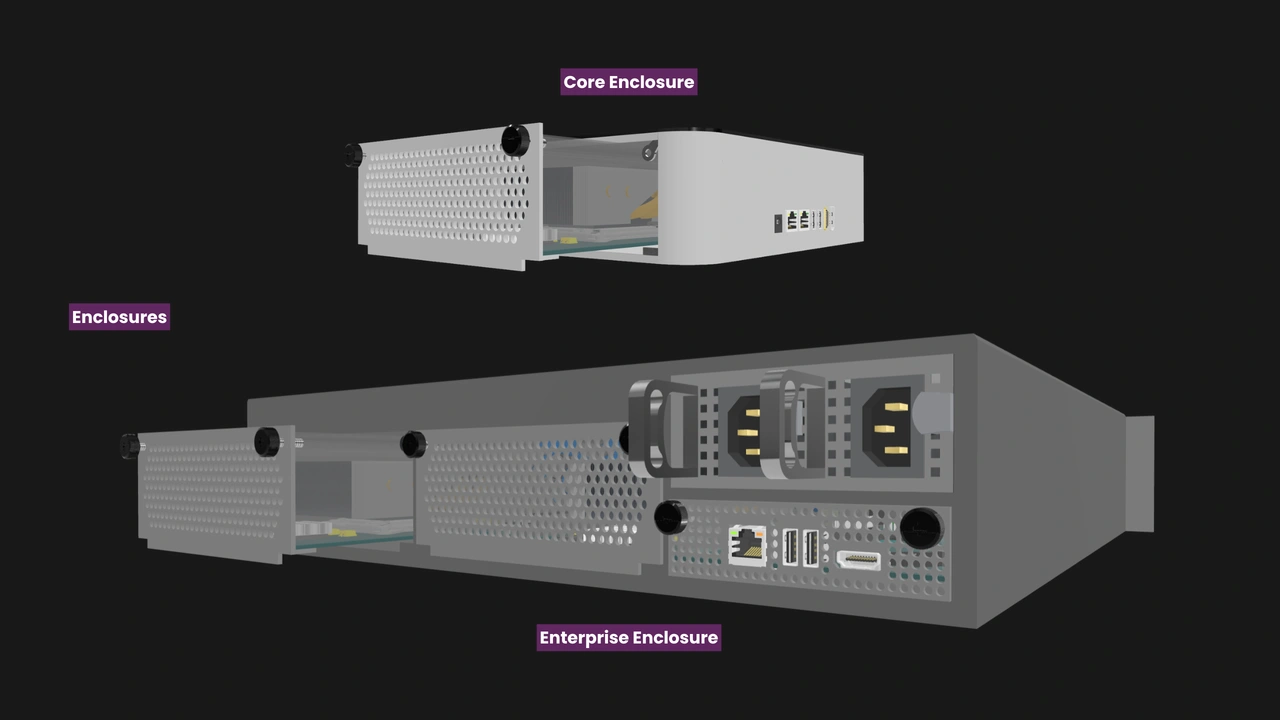
- Enclosure - A physical housing conforming to the OpenSFF Enclosure Specification. It provides the mechanical structure and required electrical and thermal interfaces necessary to host one or more OpenSFF modules (see Modules). An Enclosure may directly expose node I/O signals externally or consume those signals internally. It may also provide shared infrastructure such as network switching and management integration. As such, it cannot be labeled simply as a “chassis” or “case”.
- Enterprise Enclosure - Any compatible Enclosure implementing shared power delivery, internal Ethernet switching, and support for both node connectors (see Connectors) and the Management Module (see Modules).
- Core Enclosure - Any compatible Enclosure that does not implement all the required features of an Enterprise Enclosure.
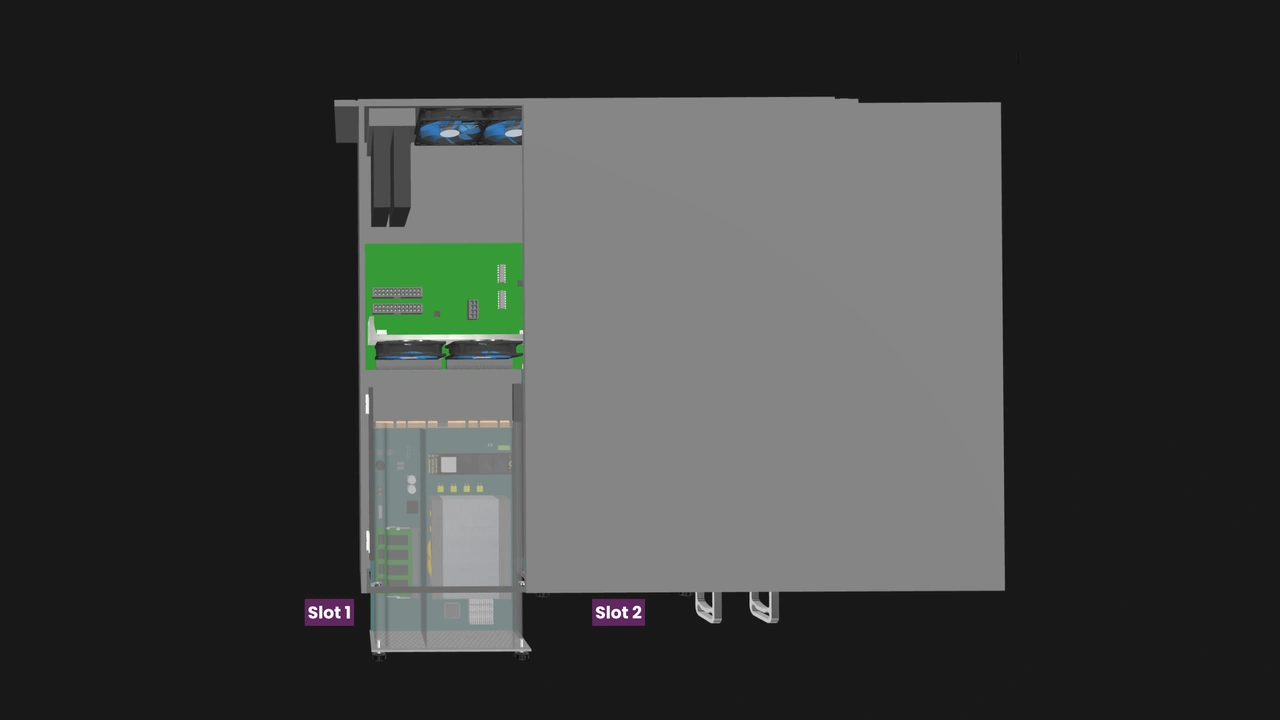
- Slot - A dedicated space within an Enclosure for Compute Nodes (see Modules). The basic unit of Enclosure capacity.
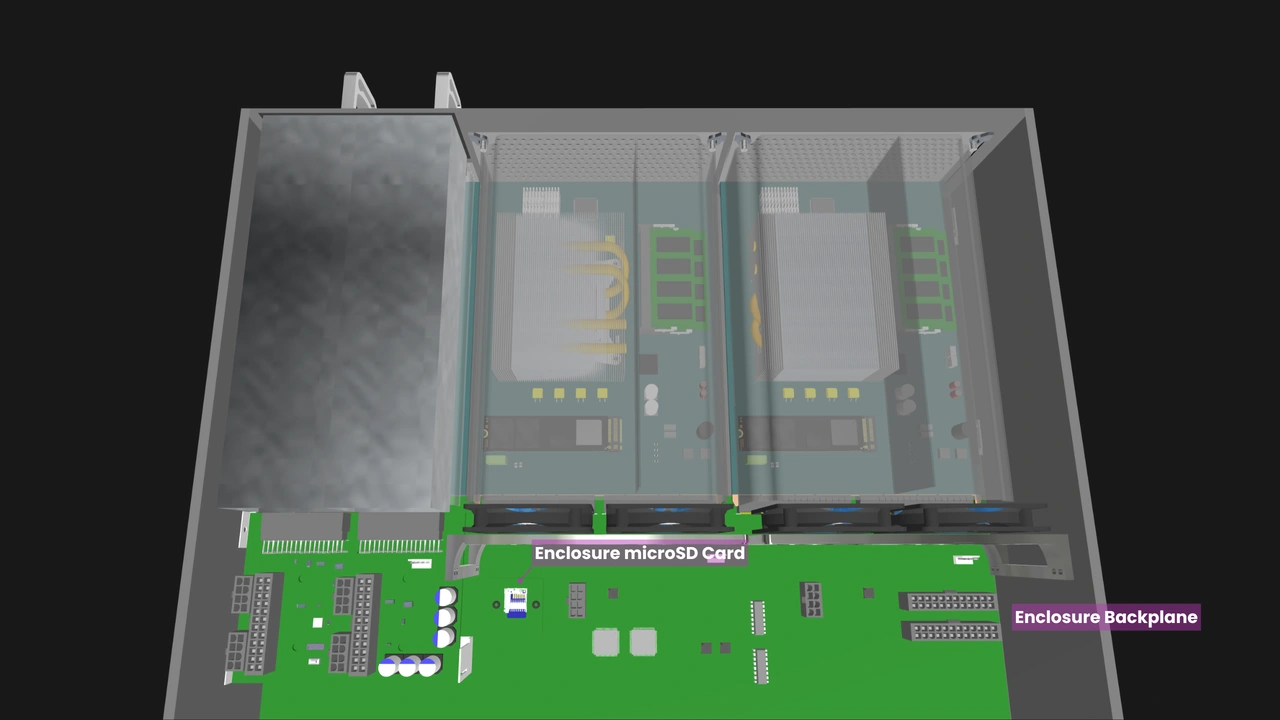
- Enclosure Backplane - The Enclosure-provided PCB infrastructure that routes power, data, and management signals between slots and shared components.
- Enclosure microSD Card (ESDC) - A user-replaceable microSD card mounted on the Enclosure backplane. It stores Enclosure metadata and backups of the Management Module configuration file.
Modules
The OpenSFF units that an Enclosure hosts. There are two types of OpenSFF modules: Compute Nodes, which run workloads, and Management Modules, which manage nodes.
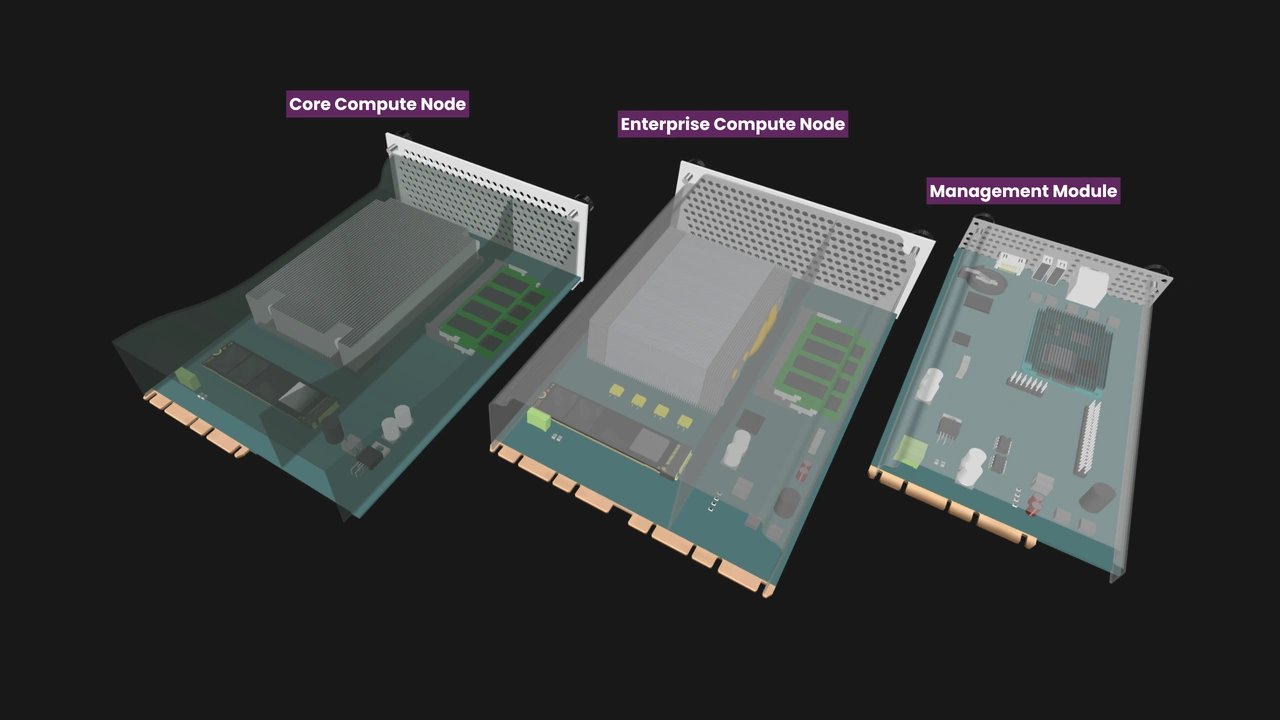
- Compute Node - A modular processing unit conforming to the OpenSFF Compute Node Specification, implementing either the Core Connector alone or both Core and Enterprise Connectors (see Connectors).
- Core Compute Node - A Compute Node implementing a single Core Connector. Fully functional in both Core and Enterprise Enclosures.
- Enterprise Compute Node - A Compute Node implementing both Core and Enterprise Connectors.
- Management Module (MM) - A removable module conforming to the OpenSFF Management Module Specification. It provides KVM redirection and out-of-band management functionality in supported Enclosures. The MM occupies a dedicated slot and connects via the Management Connector (see Connectors).
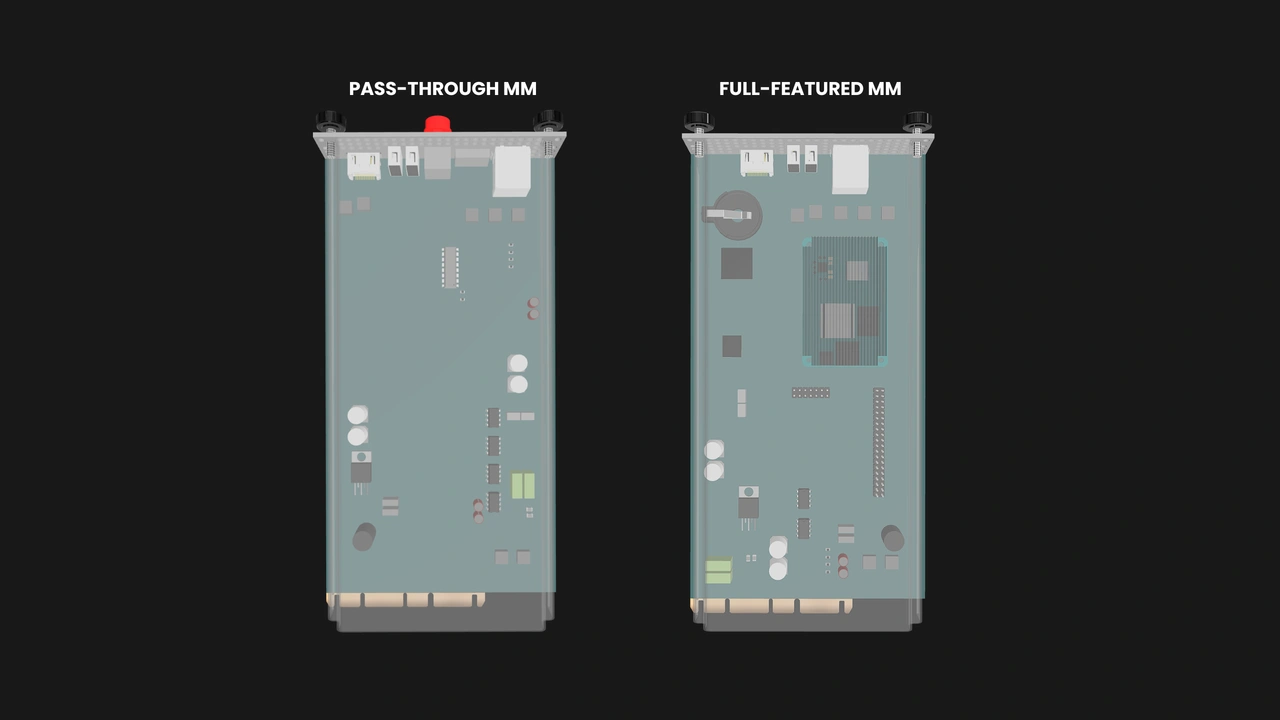
- Pass-through Management Module - A reference design of the MM that has no CPU or operating system. It routes signals directly to external ports for use with external KVM hardware.
- Full-featured Management Module - A reference design of the MM with an embedded Raspberry Pi CM5, memory, and storage. It runs a custom version of Raspberry Pi OS called OpenSFF MM OS and provides remote KVM and advanced management services over the network.
- Shroud - A plastic guide fitted to modules that directs intake air through heatsinks and components, and protects the hardware underneath.
- I/O Shield - The rear metal plate on a module. It provides exhaust flow, EMI shielding, access to external ports, and mechanical retention via two captive M4 thumbscrews.
Connectors
Physical connectivity in OpenSFF relies on three distinct card-edge connectors, all based on the SFF-TA-1002 standard.
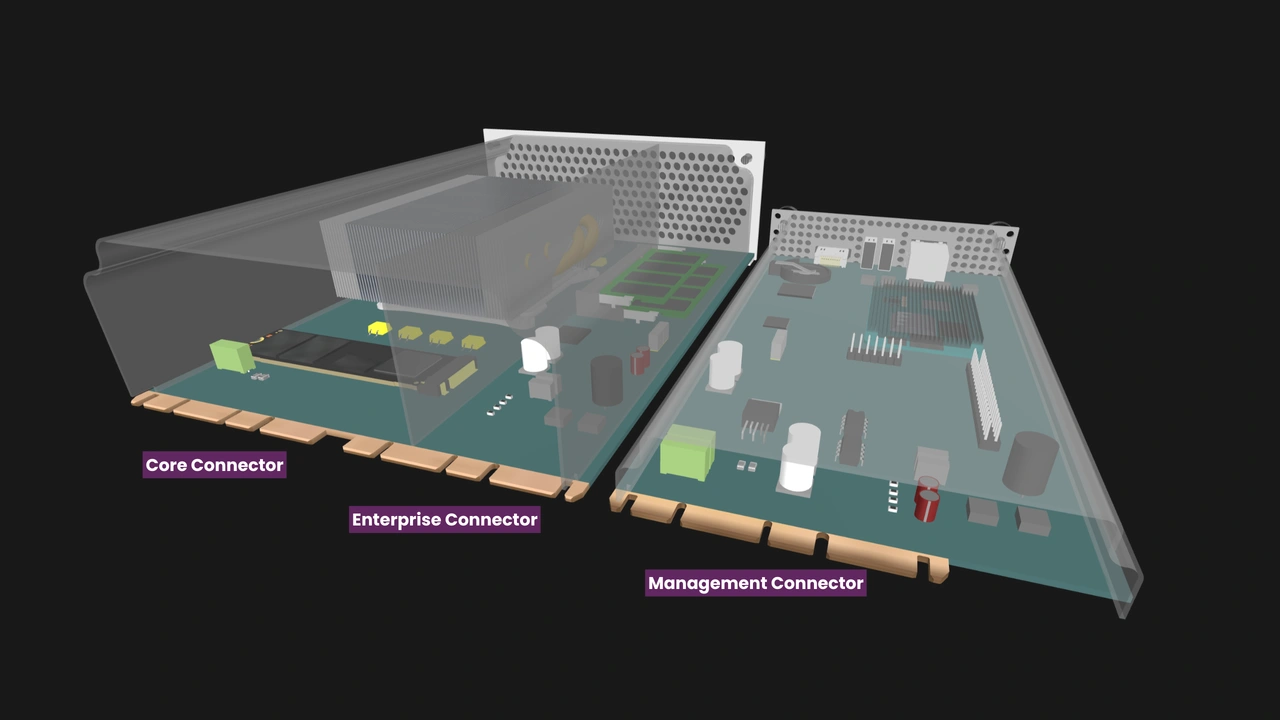
- Core Connector - SFF-TA-1002 4C+ card-edge connector implemented by both Core and Enterprise Compute Nodes. It provides electrical connectivity for power delivery, data interfaces, and control signals between the node and Enclosure infrastructure.
- Enterprise Connector - SFF-TA-1002 4C+ card-edge connector implemented only by Enterprise Compute Nodes. It provides additional high-speed interfaces beyond the baseline capabilities of the Core Connector.
- Management Connector - SFF-TA-1002 4C+ card-edge connector implemented by Management Modules (MM). It provides electrical connectivity for power delivery, data interfaces, and control signals between the MM and Enclosure infrastructure.
Networks
OpenSFF defines three distinct networks, each serving a different function.
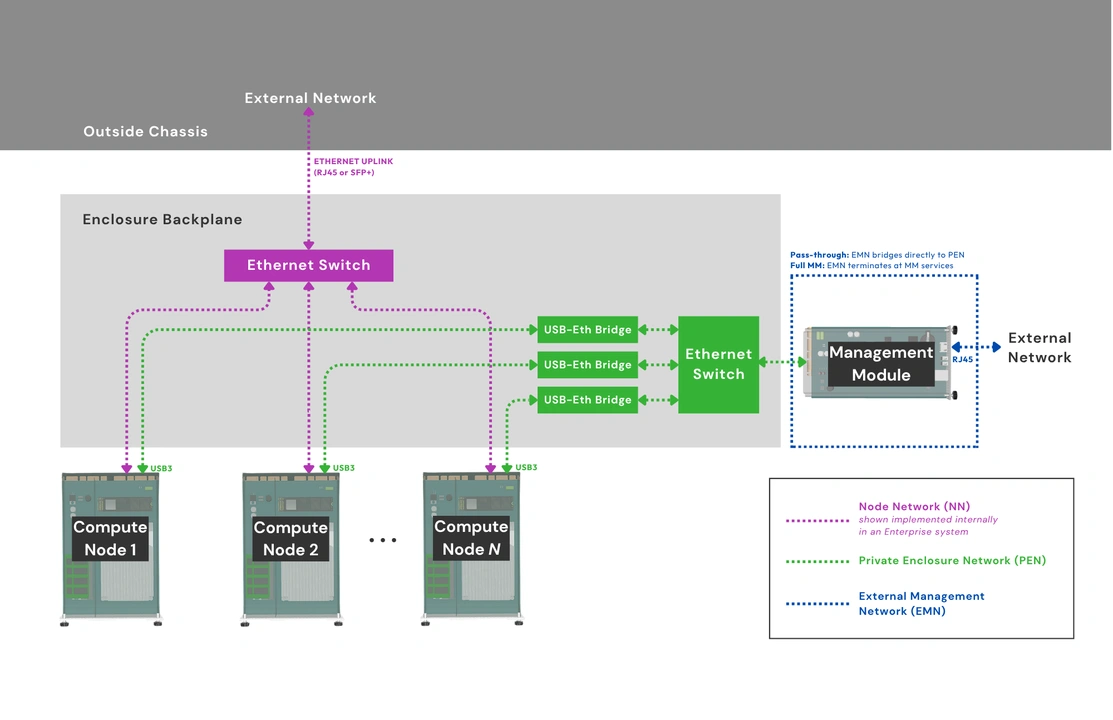
- Node Network (NN) - The general purpose data network in multi-node Enclosures. Compute Nodes use it for workload traffic, application communication, clustering, and external connectivity.
- Private Enclosure Network (PEN) - The internal and isolated switched management network within managed Enclosures (see Classification and compliance), implemented using USB-to-Ethernet adapters. Externally routable with the use of a Management Module.
- External Management Network (EMN) - The Ethernet interface of the Management Module (MM). In a pass-through MM, it provides direct wired access to the Private Enclosure Network. In a full-featured MM, it provides external administrative access to the MM's own network stack and management services.
Classification and compliance
These terms describe how systems and products are classified and evaluated. They include management configuration, power target, and designations that vendors will use to communicate their level of adherence to the standard.
The OpenSFF Compatible and OpenSFF Certified labels (work in progress). Image by OpenSFF.
- Managed Enclosure - An OpenSFF system in which a Management Module is installed and operational, enabling out-of-band management functionality such as power control, diagnostics, and KVM access. In other words, all Enterprise Enclosures can be managed Enclosures, but a Core Enclosure can also be a managed one, even if it has only one Compute Node slot.
- Maximum Power Target (MPT) - The maximum electrical power, in watts, that a Compute Node or Management Module is designed to draw under sustained full-load operation. The Compute Node has a 120W MPT, while the Management Module has a 50W MPT.
- OpenSFF Compatible - A product designation indicating adherence to the OpenSFF specifications but without formal OpenSFF certification testing. Use of this designation is limited to vendors who are OpenSFF members and have formally committed to implementing the specifications in accordance with OpenSFF requirements.
- OpenSFF Certified - A product designation indicating that an OpenSFF Compatible product has passed OpenSFF tests related to interoperability, which include electrical, thermal, and environmental tests.
Build with OpenSFF
This glossary reflects official OpenSFF terminology as of April 2026, and will be updated as the standard evolves. We encourage you to read our specifications, and we would be grateful if you spread the word about our open hardware standard. For technical clarifications, partnerships, and other inquiries, reach out to our development team at [email protected].
Other Articles

Meet OpenSFF: an open hardware standard that enables cross-vendor compatibility, modular systems, and sustainable hardware reuse.
August 11, 2025
We go over the rise of virtualization and the open software adopted by home server enthusiasts, as well as the current challenges and the future of the hobby.
September 06, 2025

Learn why OpenSFF adopted the SFF-TA-1002 connector standard and how it enables our vision.
September 18, 2025