Blog
Safe and Simple: Why OpenSFF Compute Nodes Have a 120W Maximum Power Target
Introduction
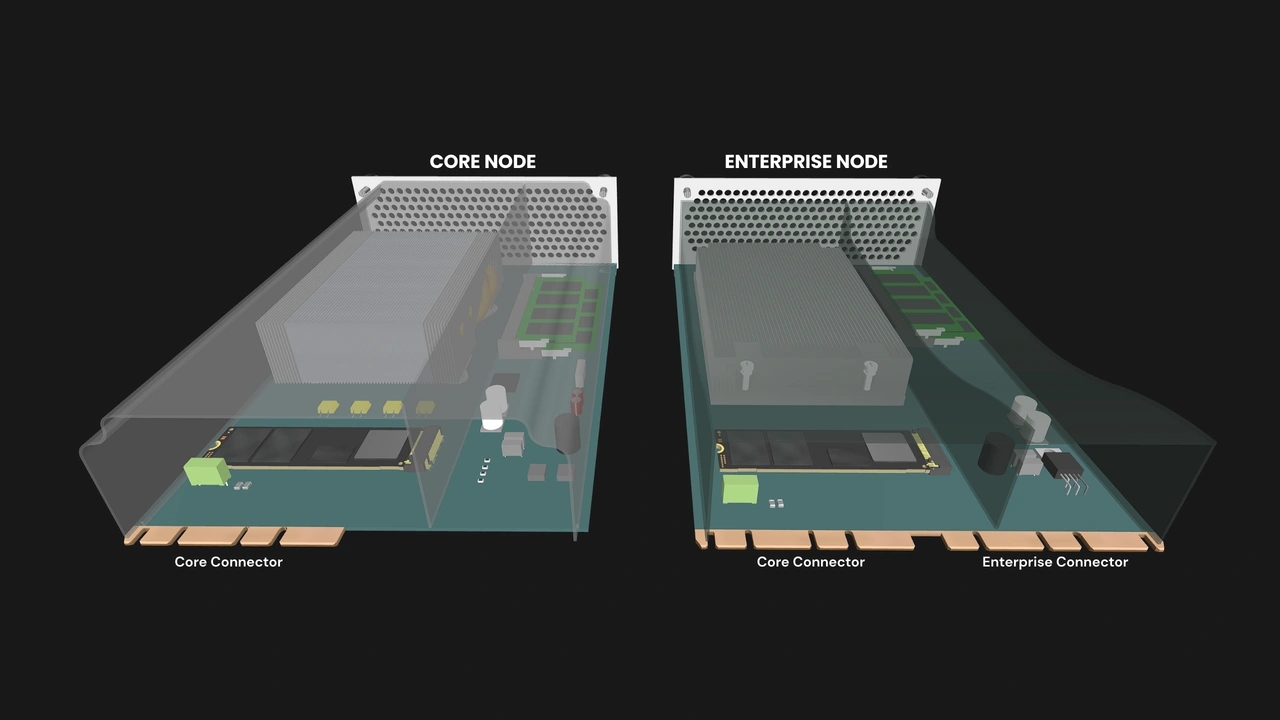
One of the most important figures in the OpenSFF Compute Node specification is the 120W maximum power target. While this target limits the scope of implementations, we are confident that 120W will be more than adequate for our intended use cases, such as edge appliances and retail servers. In addition, our standard is designed primarily for multi-node implementations, which will allow many customers to scale the capability of OpenSFF systems to suit their needs.
We set the maximum power target at 120W to ensure that compatible implementations operate safely and reliably for long periods. We also accounted for our standard’s compatibility with off-the-shelf components and air cooling solutions, to make it easier for manufacturers to design and build OpenSFF systems.
In this article, we will discuss how our adoption of the SFF-TA-1002 connector, along with third-party compliance tests, led us to our maximum power target for Compute Nodes.
How OpenSFF arrived at 120W

Table 6-3 in Section 6.2 (Electrical Testing and Performance, p. 60) of the SFF-TA-1002 specification states that, for periods longer than 1 second, the peak transient current passing through a connector pin must not exceed 1.1A. This is also the static current supported by the connector.
Table 6-4, found in the same section, indicates the electrical and operating temperature ratings of the SFF-TA-1002 connector. The values were obtained using EIA 364-70, an industry-standard test for measuring temperature rise versus current in electrical connectors and sockets. Based on the test results, SNIA determined that 1.1A can be safely carried on a maximum of six adjacent pins per connector side, for a total of 12 pins.
Table 6-4 also indicates that the safe maximum voltage rating per pin is 29V. Here is where we made our first engineering decision related to the connector’s electrical limits. We decided to set the Core Connector’s voltage rating per pin to 12V, as it is the industry-standard distribution voltage for regulators, VRMs, and DC-DC converters.
While Compute Nodes may have components that support other voltages such as 3.3V and 5V, the regulation circuits for these rails will be mounted on the node itself. This allows us to focus on the Core Connector's 12V voltage rail.
Multiplying the mandated 1.1A current limit with our practical 12V voltage rating gets us 13.2W. This is our steady state power per pin. SNIA already determined that 1.1A of power can be safely delivered through a maximum of 12 pins. To get our raw maximum power budget, we simply multiply 13.2W by 12 pins. This gives us 158.4W.
At this point, we made another engineering decision. Erring on the side of caution, we gave the connector a considerable allowance and set the limit to 120W. Thus, we have determined our maximum power target per Compute Node.
Accounting for power spikes

Transient power spikes are inevitable. They may occur at any point during operation for any number of reasons. To ensure safe power delivery during such surges, we decided to account for 200% of our maximum power target. This is the same power excursion limit that Intel set for ATX power supplies, as indicated in Table 3-3 of the ATX v3.0 specification.
Doubling our 120W target gets us 240W. Since we determined that the steady state power limit of each connector pin is 13.2W, we need 19 pins to safely deliver 240W during power spikes. We rounded this up to 20 pins because the Core Connector is double-sided and we have pins to spare.
In summary, the Core Connector has 20 pins allotted for power delivery, with each pin delivering 12V of power at up to 1.1A. Since the connector will deliver 120W for most of a compatible system’s operation, our conservative limits help ensure safe and reliable operation even for long periods.
Going beyond 120W

We firmly believe that the 120W maximum power target for Compute Nodes is adequate for our intended use cases, and may actually be a boon for efficiency and savings for some customers. But we are also leaving the door open for future versions of OpenSFF that have higher maximum power targets.
As we previously cited, the maximum voltage rating for SFF-TA-1002 connectors is 29V. There are even implementations that exceed this limit, such as TE Connectivity’s Sliver connectors (PDF). Further, SNIA also has SFF-TA-1020, which defines a variant of the SFF-TA-1002 4C connector called 4C-HP. This variant adds a high-power section capable of carrying 48V. Another related SNIA specification is SFF-TA-1037, which defines a set of connectors based on SFF-TA-1002. One of those variants is the PMM 4C+ EP connector, which is rated for 17A of current per power pin.
For the foreseeable future, we believe it is more efficient for manufacturers to design around the standard SFF-TA-1002 4C+ connector. It is widely available and proven in production environments. We will keep a close eye on relevant standards, industry feedback, and customer demands as we continue to develop our specifications.
Build with OpenSFF
The 120W maximum power target per Compute Node helps ensure that compatible implementations will operate safely and reliably. It also allows manufacturers to rely on familiar and proven electrical and thermal characteristics when adopting our standard.
Advances in chip architecture and manufacturing will likely allow manufacturers to extract more and more performance out of 120W. For instance, AMD’s Ryzen AI MAX+ 395 mobile APU consumes only up to 55W while being more than sufficient for edge AI workloads. Meanwhile, NVIDIA’s Jetson modules start at 5W and peak at just 130W, yet provide customers with plenty of performance for a wide range of embedded systems. The research and infrastructure invested into developing ARM chips may also lead to more power-efficient options for future OpenSFF systems.
Our explorations of established hardware specifications prove that no single standard can account for all use cases, even within the small form factor niche. Our maximum power target is still more than enough for many branch office clusters, edge devices, network appliances, home servers, and so much more. Especially when we consider that OpenSFF is designed primarily for multi-node implementations.
We invite you to read our specifications, and we would be grateful if you help spread the word about OpenSFF. For technical clarifications, collaborations, and other inquiries, reach out to our development team at [email protected].
Other Articles

Meet OpenSFF: an open hardware standard that enables cross-vendor compatibility, modular systems, and sustainable hardware reuse.
August 11, 2025
We go over the rise of virtualization and the open software adopted by home server enthusiasts, as well as the current challenges and the future of the hobby.
September 06, 2025

Learn why OpenSFF adopted the SFF-TA-1002 connector standard and how it enables our vision.
September 18, 2025