Blog
Hardware Restock: How OpenSFF Can Help Retail Companies
Introduction
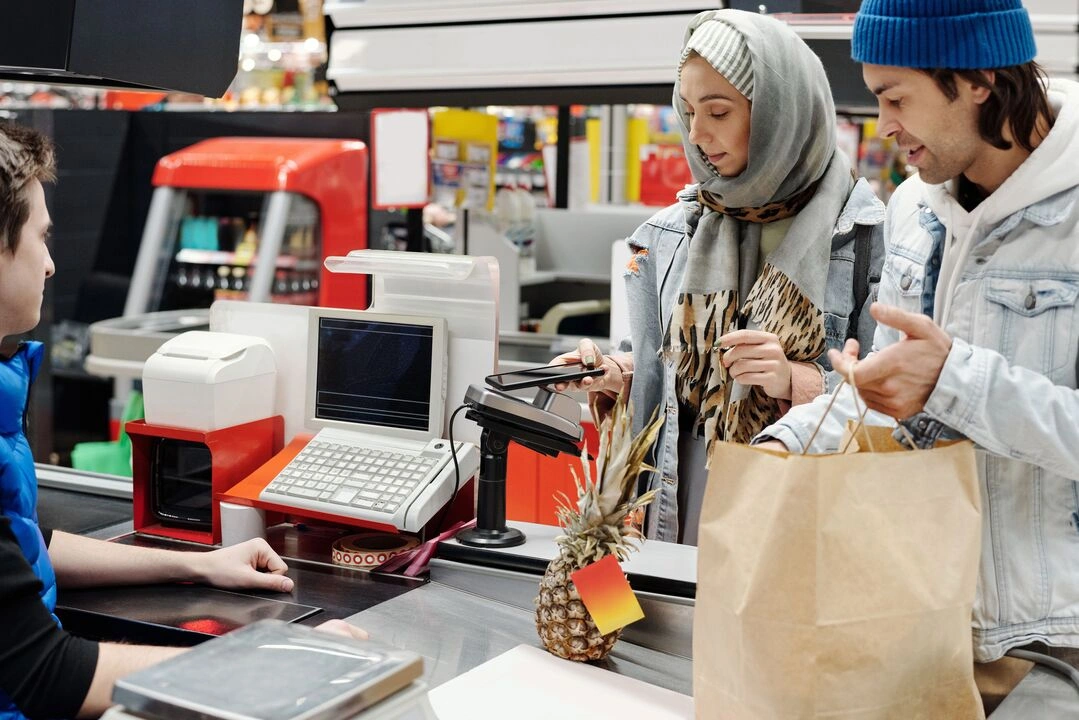
Retail branches present hardware vendors with an edge computing opportunity. Each branch runs like a small data center, with inventory systems, IoT appliances, networking equipment, and more packed into a few square meters that are mostly reserved for foot traffic and shelf space.
Moreover, retail devices are typically heterogeneous. The POS terminal is from one vendor, the NVR is from a different vendor, the router is from a third, and so on. Each device may have a different refresh cycle and support contract.
OpenSFF is a nonprofit organization developing an open hardware standard. Our specifications define three components: a processing unit called the Compute Node, an electronic housing for one or more nodes called the Enclosure, and an optional node management unit called the Management Module. Vendors can use our specifications to create a wide range of interoperable, modular small form-factor systems, including the essential devices that retail branches rely on.
In this article, we will go over the retail hardware landscape and how our standard can help create more flexible and longer-lasting solutions.
The systems used in retail
Point-of-sale terminals
Mid-market and enterprise retailers mostly run all-in-one POS terminals, where the compute unit is built into a touchscreen display or its base. Examples of this include Toshiba’s TCx810 and Clover’s line of POS systems.
However, Android-based terminals are gaining popularity, particularly in SMB retail. Counterpoint Research estimates that Android-based POS terminals accounted for about 48% of global shipments in 2025, and projects that that figure will climb to 70% by 2032. The shift is driven by Android’s familiar and open app ecosystem, as well as these devices’ ability to run payments alongside inventory, loyalty, and other business software.
Kiosks
Retail also relies on self-checkout kiosks and plenty of digital signage. Interestingly, the major vendors behind this category are moving or have moved towards modular devices. As of this writing, NCR Voyix is the leading vendor of self-checkout kiosks. Those appliances share a common platform with NCR Voyix’s tabletop units and full function (card and cash) POS terminals.
Meanwhile, many digital signage vendors have adopted Intel’s Open Pluggable Specification (OPS) and its successor, Smart Display Module (SDM), which define compute modules that slot into compatible displays. There are still basic signages that comprise displays wired to mini PCs or media players.
Store servers and inventory and ERP endpoints
More and more chains run their back office, inventory, POS, and other workloads on small, hyperconverged clusters consisting of two or three compact nodes. Scale Computing’s HE100 Series is one such example. The HCI provider has provisions to easily scale its recommended three-node cluster as customer needs evolve. SNUC is one of Scale Computing’s hardware partners. The company also offers its compact, rugged systems with built-in remote management capabilities as standalone products.
NVRs
Many retail stores also have network video recorders (NVRs) for surveillance. Appliances such as the HikVision DS-7616NXI-K2/16P, Verkada Command Connector, and Eufy PoE NVR Security Systems S4 Max typically come as rack-mounted units that have drive bays and plenty of PoE ports for security cameras.
Routers
For internet connections as well as network security and segmentation, retail chains typically use low-power routers and firewall appliances with dedicated networking chips. Examples include the Fortinet FortiGate 40F series and the Cisco Meraki MX67. These devices can consume as little as 10W under load, though there are also high-powered routers with PoE ports.
The challenges with existing hardware
Vendor lock-in
POS terminals present the highest risk of lock-in for retail chains, especially for SMBs that have only a handful of locations. For example, Clover terminals use a proprietary Android fork and are tied to Clover’s parent company, Fiserv, for payment processing.
That said, other retail devices are not immune to lock-in. NVRs for example, are often sold in bundles that come with the vendor’s security cameras, and many otherwise capable models have limited or no compatibility with third-party cameras.
OS-driven hardware refresh
This mainly applies to Windows-based systems. Millions of POS terminals and workstations are officially unqualified to run Windows 11 due to the operating system’s hardware requirements. Saving on OS licensing is another reason why Android POS terminals have dominated shipments the past couple of years. Either way, switching OSes involves discarding entire systems that are otherwise functional.
Service logistics
Keeping hardware healthy across dozens, hundreds, or thousands of locations is a constant challenge for chains. It takes time to ship replacement parts or units, and technicians may not always be available in some regions, leading to extended downtime.
How OpenSFF can help
Interoperability
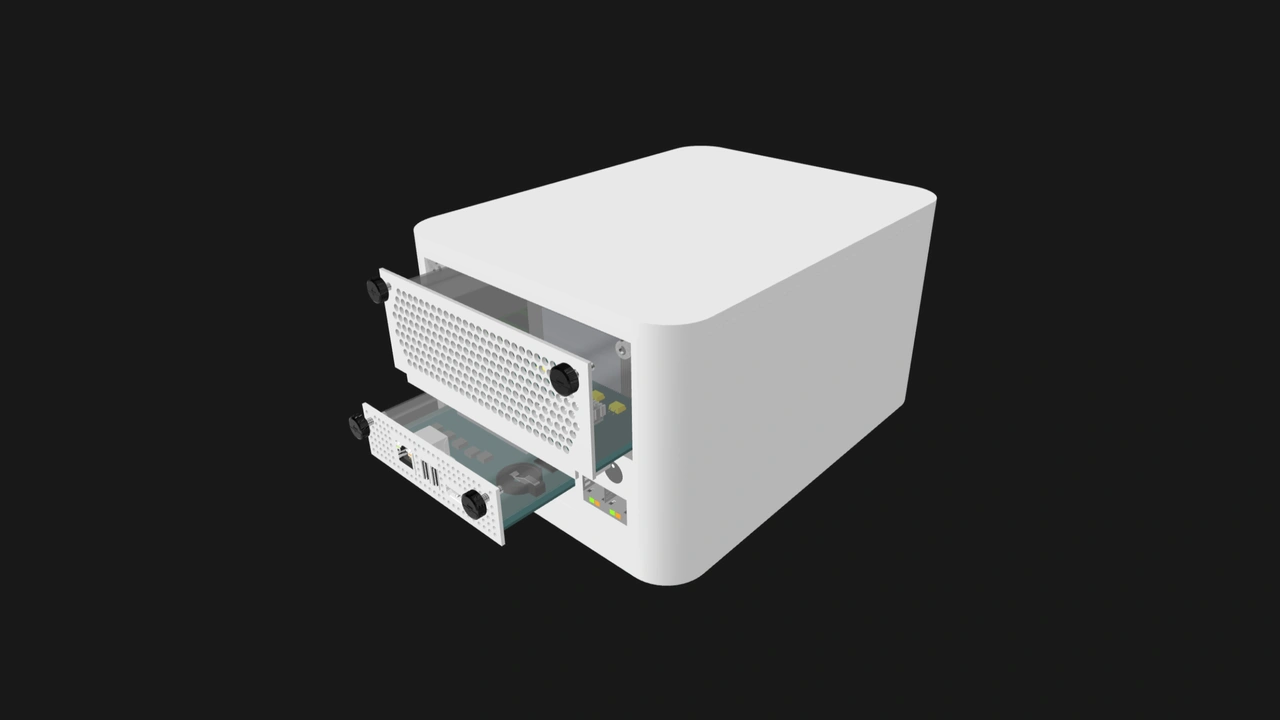
Any Compute Node is compatible with any Enclosure, regardless of their vendors. This can free retail chains from relying on a single vendor’s supply or support policies, both during procurement and in hardware refreshes.
Equally important, our standard’s interoperability is also present at the management layer. Intel’s OPS and SDM standards establish vendor-neutrality at the hardware level, but they do not standardize the management layer.
In contrast, the Management Module and its software are just as vendor-agnostic as the Compute Node and the Enclosure. Even retail chains’ HCI providers can benefit from this freedom to mix and match nodes, Enclosures, and management from different vendors instead of being walled in by a vendor’s proprietary tools and the licensing and support terms that come with those.
Agnosticism
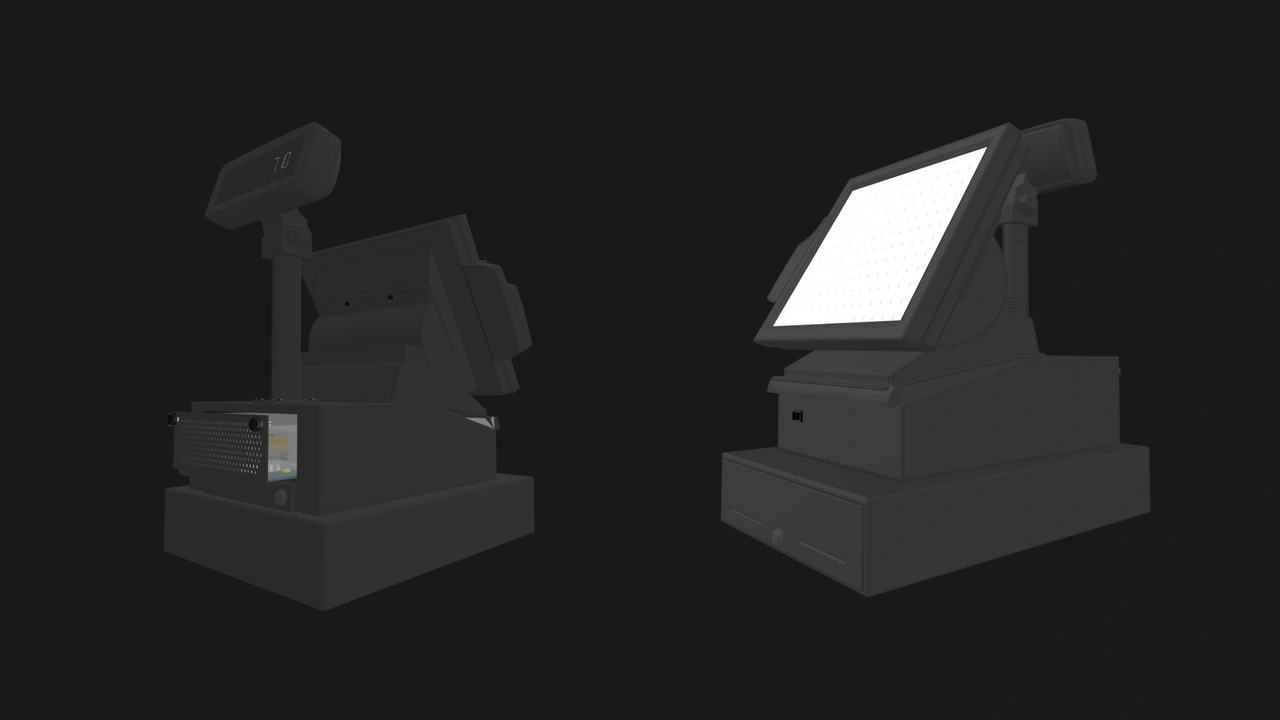
We do not mandate a particular CPU architecture or operating system for Compute Nodes. The module connectors, the KVM and power control infrastructure in compatible Enclosures, and the Management Module software are independent layers that discourage specific hardware and software combinations.
Our development team is currently working on a node telemetry daemon for Windows and Linux, but vendors can also develop an equivalent tool for other operating systems, including Android.
Modularity
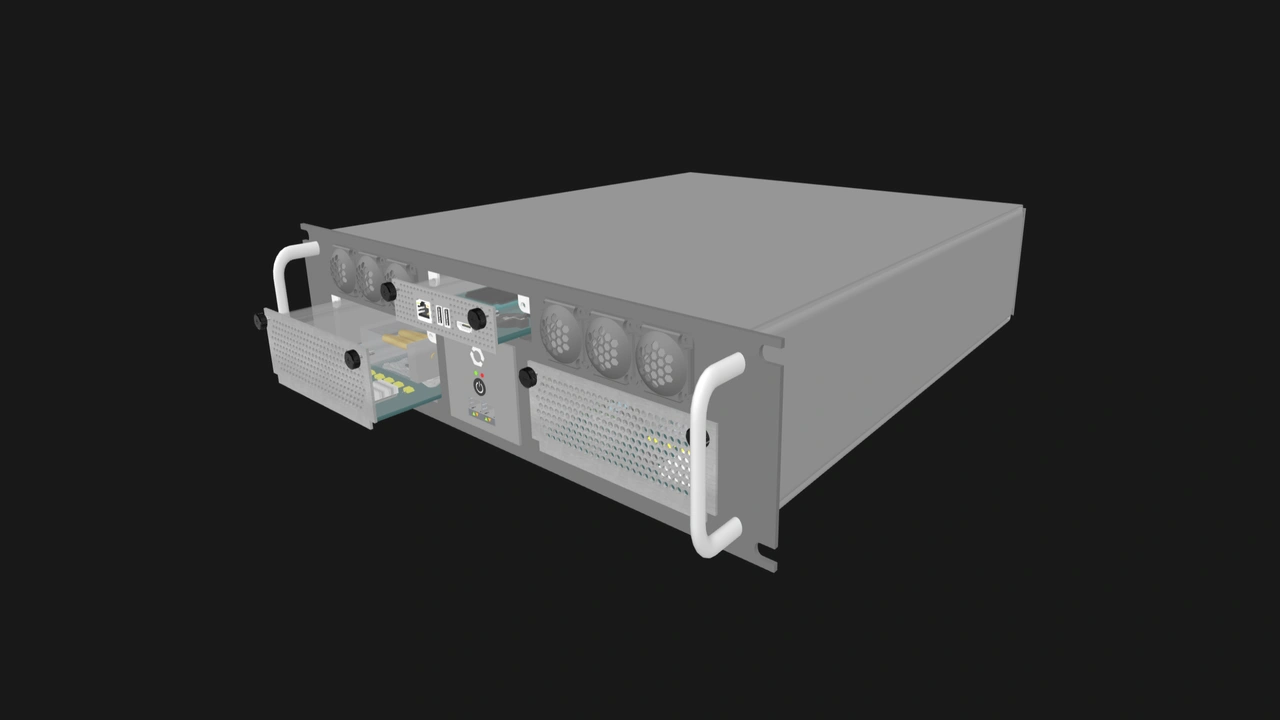
Because OpenSFF-compatible components can be replaced independently, hardware refreshes, OS migrations, or compliance requirements will not have to devolve into complete system replacements. Retail chains can swap the node in their POS terminal while keeping the original Enclosure, peripherals, and physical installation in place. They can migrate to a different server Enclosure while retaining their node along with its data and configuration.
Serviceability
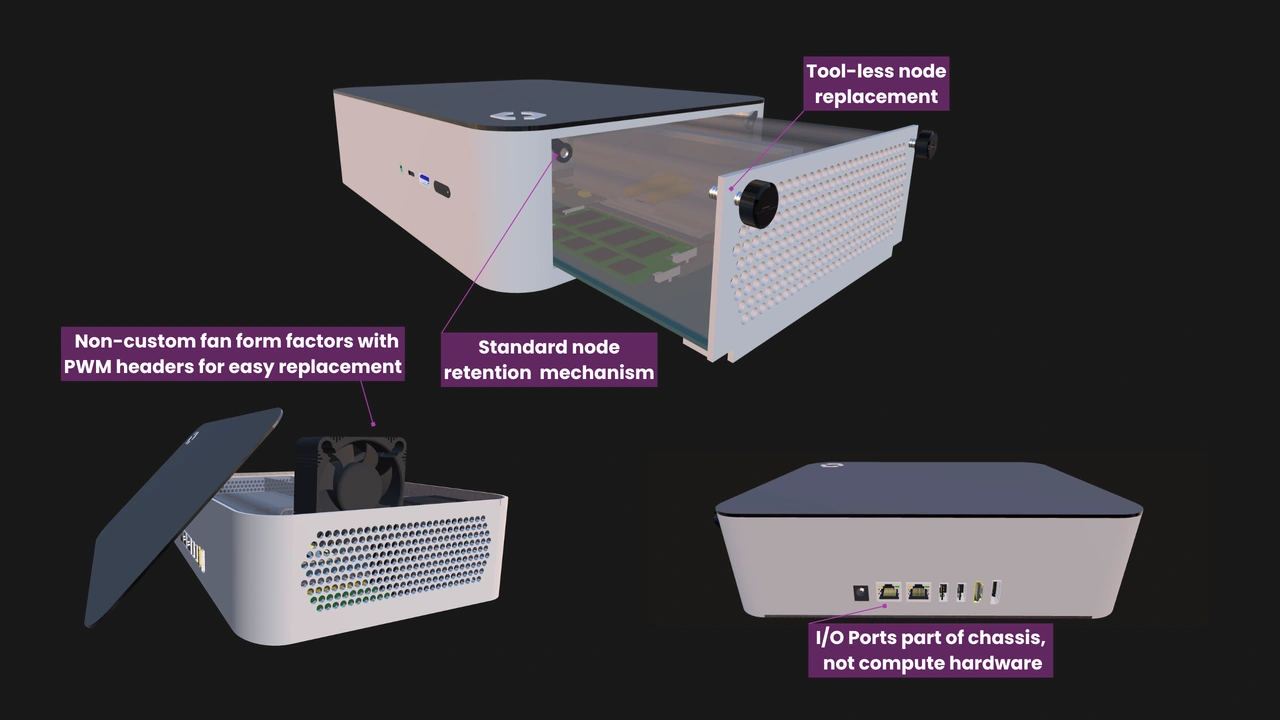
Besides sharing a connector interface, Compute Nodes and Management Modules are also secured in the same way in Enclosures: through a pair of captive M4 thumbscrews. Even on-site store staff can learn to swap a node instead of waiting for a technician to arrive. Our specifications also ask vendors to use retention mechanisms elsewhere in their implementations that do not require specialized tools.
All of these benefits are consistent across device categories. The node in an OpenSFF-compatible router will work in an OpenSFF-compatible POS terminal, server, and any other device based on our standard. This minimizes the training overhead for both in-house IT teams as well as third-party support providers. It also means that it is possible for some retail chains to store a few spare Compute Nodes that can cover multiple devices, even if only as a stopgap, as opposed to stocking one replacement unit per device.
Build with OpenSFF
Our standard does not cover all the devices that retail businesses rely on. We are not developing it for handheld scanners, laptops, or security systems that run computer vision applications. But it is highly suited for the essential systems at the edge, including the backend servers that tie store operations together. OpenSFF-compatible devices can turn retail chains into more flexible, sustainable, and resilient mini data centers.
We encourage you to read our specifications, and we would be grateful if you spread the word about OpenSFF. For technical clarifications, partnerships, and other inquiries, reach out to our development team at [email protected].
Other Articles

Meet OpenSFF: an open hardware standard that enables cross-vendor compatibility, modular systems, and sustainable hardware reuse.
August 11, 2025
We go over the rise of virtualization and the open software adopted by home server enthusiasts, as well as the current challenges and the future of the hobby.
September 06, 2025

Learn why OpenSFF adopted the SFF-TA-1002 connector standard and how it enables our vision.
September 18, 2025