Blog
Smoothening the Edges: How OpenSFF Can Enhance Edge Solutions
Introduction

Every edge deployment is different. A retail kiosk has vastly different needs from a robotics lab workbench or a gateway for an oil refinery. A restaurant usually calls for a compact computer that fits in tight counter spaces and controls the cash drawer, while a manufacturing plant may need a touchscreen PC that withstands vibration, harmful chemicals, and heavy use.
Yet edge devices have similar fundamental problems: proprietary designs, difficult upgrades, and hardware that becomes e-waste when one component fails or becomes obsolete. When a vendor discontinues a product line, their customer's loyalty is rewarded with a mad scramble for alternatives that may require different infrastructure and additional staff training.
OpenSFF’s specifications for modular, interoperable, and serviceable components enables manufacturers to create reliable edge systems while empowering businesses and increasing the lifespan of their products and components. Our standard will not be able to cater to all edge needs, but we are establishing a foundation that covers diverse solutions - including those outside of the edge - and allows them to work together.
The Edge Computing Landscape
Edge computing is not a monolith. It ranges from fanless mini PCs that fit in one’s hand to rugged servers built to comply with military specifications. But all edge devices exist for the same reason: for tasks where data needs to be processed and acted upon right where it is generated.
Processing at the edge reduces latency for time-sensitive applications, whether it be serving hundreds of diners daily, controlling an autonomous vehicle, or protecting a power station’s network from malicious entities. It reduces dependency on online services and computing power. Even when the environment has reliable Internet connections, edge devices can still be vital by filtering and aggregating raw information. If less data needs to be transmitted, it could result in significant savings in bandwidth costs in the long run. Finally, edge devices can also be crucial for security and privacy by keeping sensitive data on-site.
Edge devices are quite fascinating, both in terms of their individual designs and their variety. Some are miracles of design and engineering. Perhaps most importantly, edge devices reveal just how omnipresent and essential computers have become. From fast food chains and digital billboards to power stations and factories, the modern world relies on edge devices to run smoothly.
Examples of edge devices
TouchDynamic Saturn DV J1900
The Saturn DV J1900 is a compact edge device designed to be a POS and kiosk computer. Released in 2018, it has an Intel Celeron J1900 CPU, three RJ45 RS-232 ports, a cash drawer port, and a compact and ventless case.
We highly recommend watching the video above, in which Hardware Haven opens up a Saturn DV and tries to repurpose it. Besides being entertaining, it is a great introduction to edge devices.
NVIDIA Jetson Orin Nano
The Jetson Orin Nano is another tiny edge device, but one that is on the bleeding edge. It is designed specifically for generative AI and machine learning applications, thanks to its integrated NVIDIA Ampere GPU. It also has a pair of MIPI CSI camera connectors for visual tasks such as object detection. As shown in Dave’s Garage’s video, the Jetson Orin Nano is powerful enough to run Vision Language Models and Large Language Models at a practical pace. It does it all while being unobtrusive, silent, and power-efficient.
SolidRun HummingBoard RZ/G2L
The HummingBoard RZ/G2L is a single board computer (SBC) meant for human-machine interfaces, robotics, and other gateway applications. It supports the RS232, RS485, and CAN-FD protocols, as well as PoE for power delivery. Its optional aluminum enclosure enables it to operate under a wide temperature range, from -40°C to 85°C.
Lanner ICS-P375
The ICS-P375 is an industrial cybersecurity gateway. It is meant to protect the networks of critical infrastructure such as power stations, railway stations, and oil and gas facilities. It is pre-certified for operation in harsh environments, as well as in compliance with the communication and safety requirements of its intended settings.
OnLogic TC401 - All-in-One Industrial Panel PC
The Tacton TC401 is an all-in-one PC for industrial environments, kiosks, and vehicles. It can be configured with resistive or capacitive touchscreen panels ranging from 12” to 21.5”. It also supports OnLogic’s ModBay, a proprietary expansion slot for additional I/O, and can be equipped with a 4G modem and antennas.
The limitations of existing edge devices
As we saw in our examples, the compute units in many edge devices are not designed to be separated from their chassis. If either component needs to be replaced, the rest of the system goes with it, even if those other components are still functional.
This static design makes it difficult to service systems and repurpose components. Enclosures that may still be compliant end up being discarded because the compute unit cannot be upgraded. Compute units that are functional become e-waste because they are incompatible with many off-the-shelf parts.
These restrictions ultimately lead to unnecessary waste and restrict businesses’ options when procuring and maintaining edge devices. They are also significant obstacles for potential competitors that could otherwise offer better options.
The OpenSFF advantage: modularity and interoperability
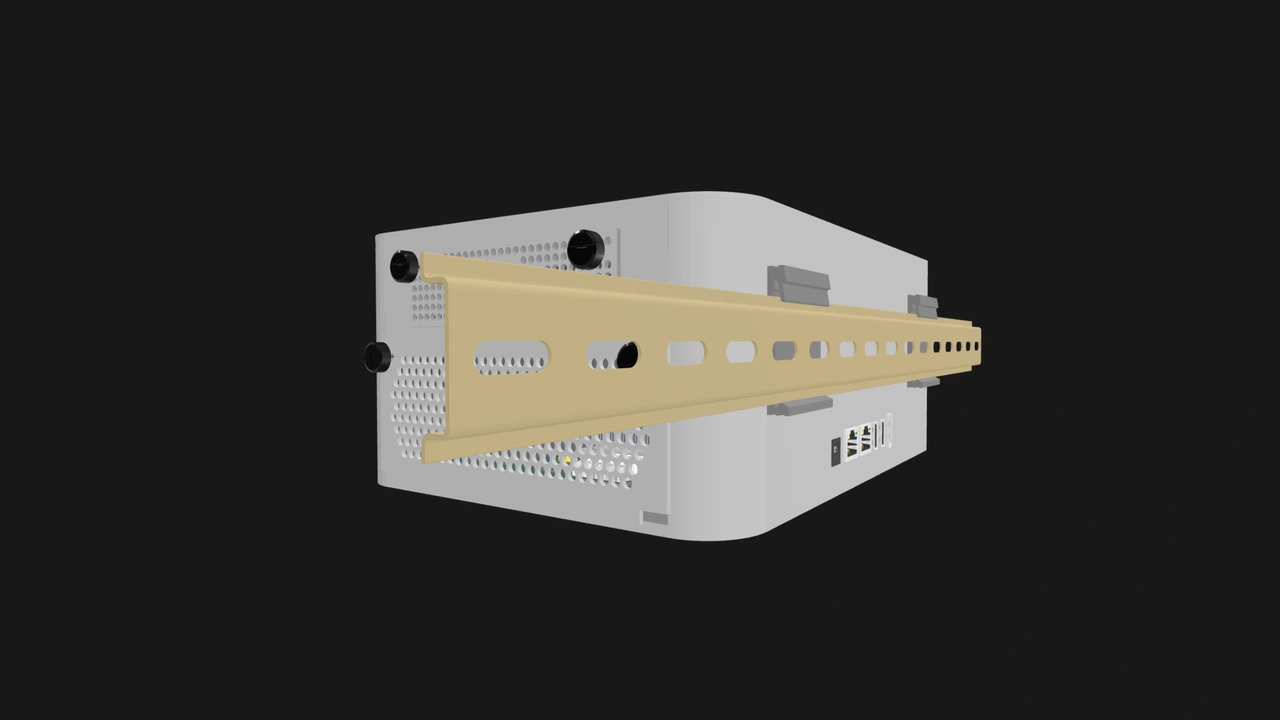
The Compute Node is a self-contained processing unit that is mounted to an Enclosure via a pair of captive M4 thumbscrews. All Compute Nodes are compatible with all Enclosures, regardless of their vendors. These two requirements enable the creation of edge devices that:
Simplify inventories: OpenSFF thrives in scenarios where numerous similar systems need to be deployed long term. For instance, the regional warehouse of a fast food chain can stock 20 Compute Nodes as spare components for 200 POS computers.
Enable cost-efficient and sustainable service and reuse options: Compute Nodes can be upgraded without discarding or even unmounting functional Enclosures. Similarly, damaged Enclosures can be replaced while retaining the original Compute Node. This can significantly reduce downtime and help preserve compliant installations, which are especially crucial in critical infrastructure.
Outdated yet functional Compute Nodes can be cascaded to less demanding applications such as workstations or thin clients, rather than being scrapped. These Compute Nodes should also be easier to sell in used markets, as they are compatible with all Enclosures.
Help avoid vendor lock-in: OpenSFF opens the door to vendors and OEMs that specialize in Enclosures, Compute Nodes, or Management Modules instead of complete systems. This should foster a more competitive and diverse market, which would help businesses be more flexible when procuring and maintaining edge devices. Users may also be able to switch to a different CPU architecture without overhauling their infrastructure.
The limitations of OpenSFF in edge deployments
There are cases where OpenSFF components would not make for the optimal edge device. Our standard:
Is unproven in harsh environments: It will take a long time before we see OpenSFF devices that are pre-certified for specific industries, compared to existing solutions such as the Lanner ICS-P375.
Has a 120W maximum power target for Compute Nodes: Our standard cannot be used to create systems with power hungry components such as certain enterprise CPUs and discrete GPUs.
Is best for mid-sized systems: Custom designs, barebones kits, and SBCs can be significantly smaller than systems made with OpenSFF components. But we firmly believe that this is an acceptable tradeoff for having modular, interoperable, and serviceable edge devices.
Build with OpenSFF
Edge devices evolved to thrive in their respective use cases and environments. For certain scenarios, custom solutions will remain the optimal solution. Yet they are too important and prevalent to remain largely fragmented and unsustainable.
Edge devices are ultimately computers. As compute performance steadily becomes more space- and power-efficient, there is no reason why many edge devices would not be able to adhere to a standard that empowers users and promotes hardware longevity, while still fostering innovation.
OpenSFF does not prescribe what edge computers should look like. It enables different products and markets to work together. Enclosures can be minimal or feature-packed. They can be standalone or compatible with VESA, DIN, or rack mounts. They can be headless or have displays and other interfaces built-in. The OpenSFF ecosystem reinforces itself through vendor participation and user demand.
We encourage you to read our specifications, and we would be grateful if you help spread the word about OpenSFF. For technical clarifications, partnerships, and other inquiries, reach out to our development team at [email protected].
Other Articles

Meet OpenSFF: an open hardware standard that enables cross-vendor compatibility, modular systems, and sustainable hardware reuse.
August 11, 2025
We go over the rise of virtualization and the open software adopted by home server enthusiasts, as well as the current challenges and the future of the hobby.
September 06, 2025

Learn why OpenSFF adopted the SFF-TA-1002 connector standard and how it enables our vision.
September 18, 2025