Blog
Building Blocks: What OpenSFF Can Learn from Modular Hardware Startups
Introduction
OpenSFF is a nonprofit organization developing open hardware specifications for modular, vendor-agnostic, and serviceable computing systems. As we develop our standard, we’ve been looking at similar projects that validate our mission and teach us valuable lessons. We explored motherboard standards from industry titans such as Intel, and studied the community-first strategies of maker platforms such as Adafruit. This time, we’ll be focusing on three companies behind some of the most promising modular consumer electronics available today.
MNT Research, Framework Computer, and Khadas Technology are all relatively young businesses, and none of them are currently building toward a cross-vendor ecosystem. But like us, they use modularity to uphold their principles. We can learn a lot from how these three companies get people to care about their vision, and how we can protect that precious support.
MNT: modularity as a philosophy
Founded in 2011, MNT Research GmbH creates privacy-focused, DIY-oriented devices. Its primary product line is the MNT Reform, a trio of laptops. The Reform line has a deliberately retro, chunky aesthetic—a visual nod to their predecessors, when they were “modifiable tools rather than consumption devices.” That philosophy manifests in swappable processor modules, batteries, storage drives, and even keycaps.
The latest member of the Reform line, the MNT Reform Next, takes modularity to the next level by separating I/O from the motherboard. The ports on either side of the laptop, the Wi-Fi and Bluetooth chips, and the audio components are separated into “port boards.” The Reform Next’s camera and its supporting hardware also have their own module and are completely optional.
For MNT, the right to repair is just as important as empowering its users. The company sells replacement parts on its online store, but many of the components in its laptops are commodity parts that you could get elsewhere. MNT also says that it mainly uses standard components in its PCBs, which makes it easier for modders and repair shops to source replacements.
Out of the companies we’re looking at today, MNT is OpenSFF’s closest analog. It publishes design files, schematics, and source code on GitLab. The original Reform laptop has also been certified open-source by the Open Source Hardware Association (OSHWA). These efforts have resulted in MNT’s community giving back to its projects, such as Debian integration, an OpenBSD port, and an open-source USB camera module. MNT continues to prove that open-source projects are inherently more secure and have a higher ceiling for improvement than proprietary systems. Slowly but surely, the community effectively becomes an extension of MNT’s engineering team, motivated by passion and curiosity rather than profit.
Framework: modularity as an experience
Framework launched in 2020 with a pitch that’s more focused than MNT’s: modular laptops that look and feel like modern devices. Where MNT’s modularity goes hand-in-hand with its openness, Framework uses it in the name of repairability and customization.
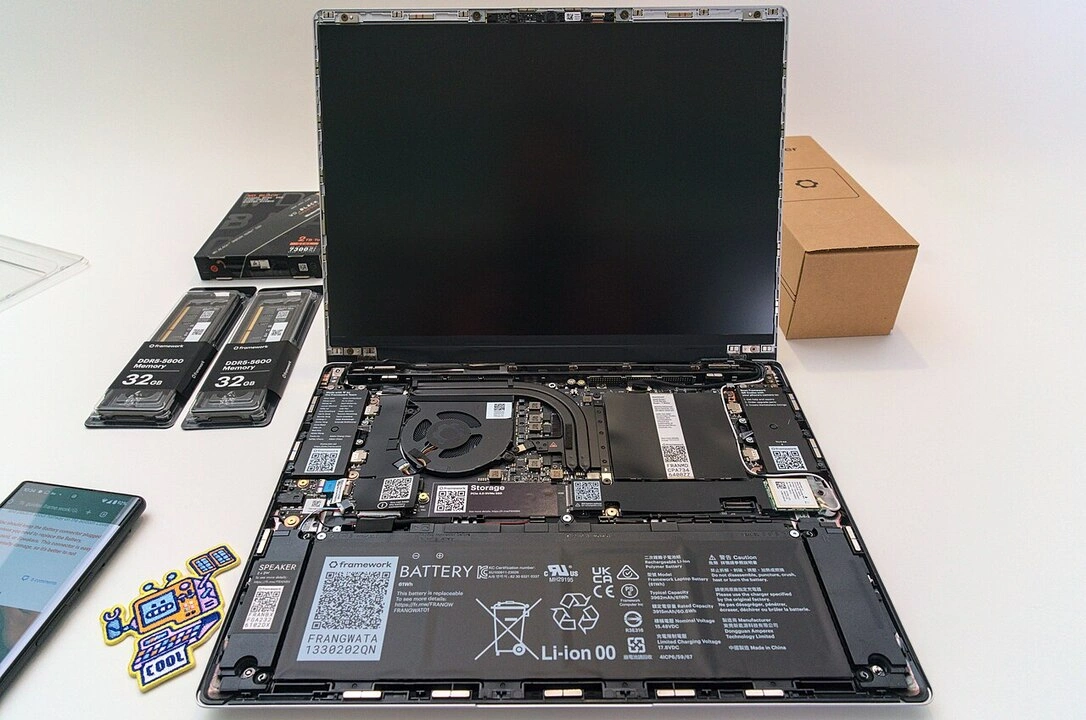
Framework laptops don’t have swappable processors, but their mainboard is replaceable, as are the battery, RAM, Wi-Fi card, and other internal components. Framework also has an online store that offers replacements for these internal parts. The company’s signature feature is the USB-C Expansion Card system, which lets users customize the ports on their devices. More recently, the company released an optional GPU expansion module for its 16" laptop. This monumental achievement makes the Framework Laptop 16 arguably the most unique and upgradeable laptop ever made. Framework also uses modularity for aesthetics, offering a range of bezel and keyboard colors for its 13” and 16” laptops.
Framework isn’t as open as MNT, but it does share CAD files for its laptop chassis and Expansion Cards. Partial schematics for its mainboards are also publicly available, and the firmware for its laptop controllers is open-source. These efforts have already resulted in third-party contributions that you can actually get your hands on today. Cooler Master makes a Mainboard Case that lets users turn their retired mainboard into a mini PC. Even more intriguing is DeepComputing’s RISC-V Mainboard for the Framework 13—a peek into a cross-vendor Framework ecosystem.
Framework’s defining strength is making its laptops user-serviceable. Its laptops are significantly easier to tear down compared to competing devices. The laptops’ internal components are clearly labeled and even come with QR codes that take you to their corresponding page on the Framework parts store. The Expansion Cards allow users to customize their device’s ports without using tools. The company also shares full schematics and assembly drawings to repair shops, making it easier for users to get help with trickier hardware issues.
Khadas: modularity as flexibility
Founded in 2016, Khadas is the most traditional consumer electronics company on our list. It uses modularity to entice customers to embrace its hardware ecosystem. Khadas offers a couple of standalone devices that can be maximized only by pairing them with the company’s peripherals.
The Khadas Mind is a family of x86 mini PCs. Each one works fine on its own, but their defining feature reveals Khadas’ hand: a proprietary 122-pin magnetic connector that lets users connect a Mind computer to a set of purpose-built accessories. The Mind Dock offers an array of additional ports, the Mind Graphics is an eGPU module, and the Mind xPlay turns the mini PC into a laptop.
The Khadas Edge2 on the other hand is an ARM-based single-board computer aimed at makers. It has a pogo-pin connector for add-ons, as well as multiple connectors for cameras, displays, and sensors.
The Mind and Edge lines both lean into Khadas’ slim, minimalist industrial design. The Mind family in particular is built for users who regularly move from one computing setup to another. Users can have the Mind Dock or Mind Graphics on their desk, and the Mind xPlay in their bag. The Mind lets users carry their data and workspace with them.
The Mind and Edge connectors let Khadas hone the interface and user experience to its vision instead of being constrained by an open standard. They’re even more convenient and transformative than Framework’s Expansion Cards, allowing users to transform their Khadas product into a completely new device without cables or tools. The tradeoff is that users are completely reliant on Khadas to continue to support and expand its hardware ecosystem.
What OpenSFF can learn from these companies
In terms of resources, reputation, and visibility, OpenSFF has a lot more in common with MNT, Framework, and Khadas than the likes of Intel or OCP. We’ve yet to build deep industry relationships or earn the trust of millions of end users. But like the three companies on our list, we have the ability to talk directly to the vendors who’ll adopt our standard as well as the people who’ll use those vendors’ products. These companies have shown that we can earn support through how we communicate rather than through market share.
Communicate regularly
MNT’s openness extends into its communications. It posts monthly updates on its news page and on its crowdfunding projects on Crowd Supply, covering everything from prototypes and development progress to personal reflections and community gatherings. Framework’s CEO Nirav Patel reminds us of Adafruit founder Limor Fried in that he’s also the company’s main spokesperson. He writes most of the company’s blog posts, hosts many of its product videos, runs Q&A livestreams, and posts directly in Framework’s official forum. Like MNT, Khadas also posted regularly on Kickstarter to talk about the Mind’s testing or production milestones.
Grow the ecosystem through documentation and essential tools
These three companies remind us that publishing our specifications is only the first step in a never ending journey to expand the OpenSFF ecosystem. Their ongoing releases of source codes, firmware, kernels or drivers allow their communities to enhance and expand their products.
Be transparent about challenges, constraints, or tradeoffs
MNT, Framework, and Khadas have been fairly honest when things don’t go as planned. MNT and Khadas discussed shipment delays in their crowdfunding campaigns. MNT has also talked about bugs and problems with their suppliers. Framework, for its part, has posted about price increases tied to tariffs and chip shortages.
MNT and Framework have also been candid about compromises due to their reliance on third-party technologies. In an early update during the Reform’s crowdfunding campaign, MNT explained that they chose the aging NXP i.MX6QP to be the laptop’s default system-on-a-chip (SoC) due to the accessibility of its documentation as well as its mainline Linux support. A few months later, the company relented and adopted the newer i.MX8M SoC. Once again, they updated their backers, emphasizing that the chip involves closed-source firmware.
Meanwhile, in a Linus Tech Tips video about the Framework Desktop, CEO Nirav Patel addressed criticisms regarding the PC’s soldered RAM. Patel revealed that they actually asked AMD if there was any way to make modular memory work on the Strix Halo-powered computer. However, AMD’s tests revealed that signal integrity broke down over the 256-bit memory bus at the required speeds.
Khadas, for its part, has generally been responsive to posts on its official forum about issues or feature requests, even when its answer isn’t what the community was hoping to hear.
Putting the lessons into practice
Create a lively community, and live in it
We won’t be selling our own OpenSFF products, and we won’t have complete control over the products that vendors make based on our standard. But we should still have an official public channel, and we need to be active participants in it. Our community would appreciate that we take the time to listen to their feedback, that we’re interested in their contributions, and that we’re also users with similar frustrations and struggles with existing hardware.
Empower vendors and makers, not just end users
Aside from keeping our published specifications up to date, we should also share as many resources and tools as possible to make it easier for creators to adopt or build upon our standard. Maintaining documentation and repositories is thankless work, but it’s not optional.
Be the first to talk about tradeoffs and setbacks
We should be the primary source of information on what we prioritize and what we sacrifice, such as our node power target, PCIe lane allocation, or the capabilities of our software. In the same vein, we should be transparent about our challenges. Speculation tends to fill in for silence, and we may not be able to maintain people’s attention and trust if we don’t publicly address our setbacks.
Walk the talk
We need to recognize that our values heavily imply what our stance will be on certain issues and which partners we should or shouldn’t work with. Framework drew criticism for supporting open-source projects led by toxic communities or racist figures. If we’re going to establish our community around principles rather than profit, we should always keep in mind that we’re part of an assertive and vocal minority. That’s the spirit that led us to create OpenSFF in the first place.
Build with OpenSFF
MNT, Framework, and Khadas each have plenty of room to grow. Depending on who you ask, their current products may still have a way to go before they can match the polish or value of more established mass-market alternatives. But it’s worth remembering that none of them have their competitors’ R&D budget or manufacturing capacity. In many cases, they have no choice but to use components that were never designed for modularity, serviceability, or customizability to begin with.
That’s what matters more for us, that these companies shipped viable modular products against all odds. Alongside that, they show us that we should communicate openly and frequently, even when there’s bad news to share. We believe that time and technology are on their side, and on ours as well.
If you enjoyed reading this, we encourage you to learn more about our specifications, and we would be grateful if you spread the word about OpenSFF. For technical clarifications, partnerships, and other inquiries, reach out to our development team at [email protected].
Other Articles

Meet OpenSFF: an open hardware standard that enables cross-vendor compatibility, modular systems, and sustainable hardware reuse.
August 11, 2025
We go over the rise of virtualization and the open software adopted by home server enthusiasts, as well as the current challenges and the future of the hobby.
September 06, 2025

Learn why OpenSFF adopted the SFF-TA-1002 connector standard and how it enables our vision.
September 18, 2025