Blog
Mini PC, Major Fragmentation: How OpenSFF Can Simplify Small Computers for Everyone
Introduction

The mini PC market is booming. It was already worth an estimated $23.5 billion in 2024, with a projected compound annual growth rate of 5% through 2031. But with this explosive growth comes heavy fragmentation. Hundreds of proprietary SKUs, vendor lock-in, and the lack of a form factor standard threaten to overwhelm prospective buyers and culminate into a needlessly complex ecosystem.
In this article, we will go over the strengths of mini PCs, the consequences of its fragmented market, and how OpenSFF’s open and modular hardware standard can enable mini PCs to become a true platform rather than a disposable appliance.
Why people love mini PCs
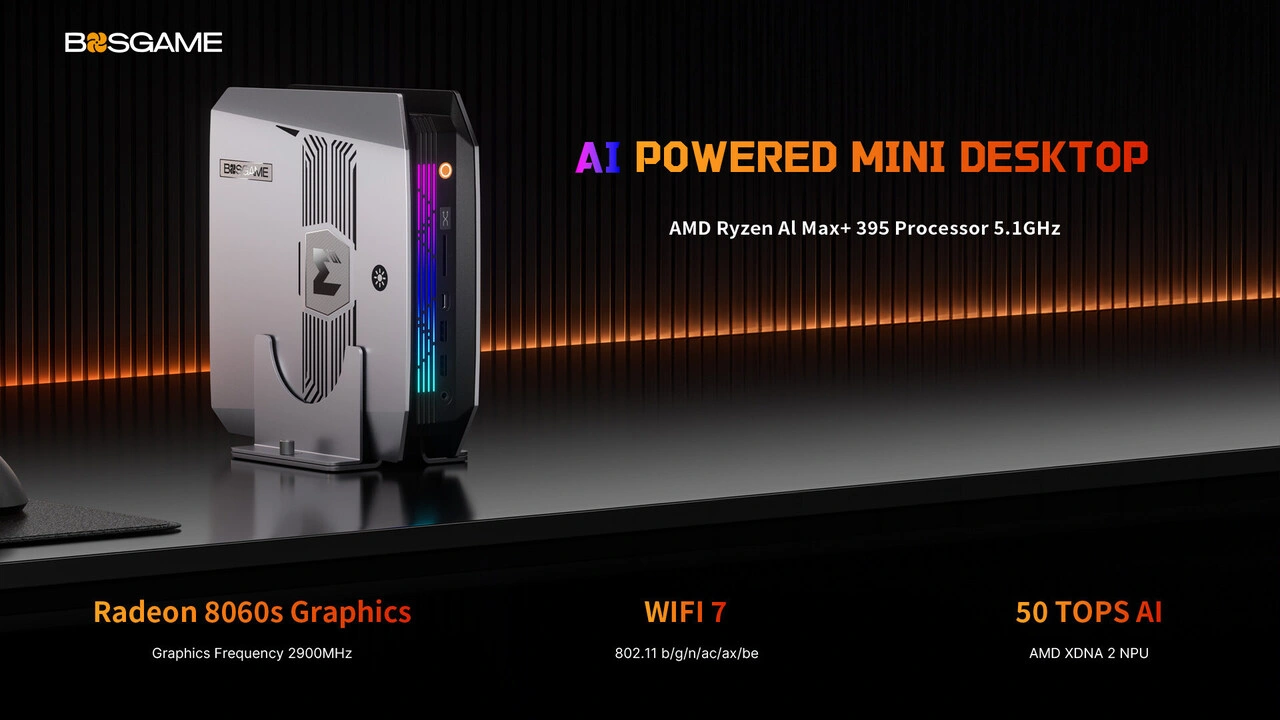
What started as a low-powered machine for casual use has evolved into a dominant triple threat that delivers desktop-class performance in a compact package.
Power efficiency
Next to their size, performance per watt is the greatest strength of mini PCs. They consume up to 80% less power than traditional desktops, saving users up to $100 in power bills annually. Equally important, this efficiency also results in dramatically lower heat and noise produced. These characteristics are highly desirable to all demographics, from home users to businesses.
Performance
Mini PCs have long shed their reputation as underpowered systems. AMD’s mobile processors have contributed greatly to this transformation, and it appears that the company is just getting started. Strix Halo, the most powerful APU in AMD’s Ryzen AI series, has resulted in premium mini PCs such as the Framework Desktop, GMK EVO-X2, and Beelink GTR9 Pro that are viable for AI workloads and mid-range gaming. Such use cases were once unimaginable for machines that could fit in one’s hand.
Value proposition
Despite the increasing availability of more powerful (and expensive) mini PCs, there is still a growing demand for affordable or cost-efficient systems. For $200 to $400, customers can now have the efficiency and performance previously exclusive to higher price tiers just a few years ago.
Even Apple could not stop itself from leveraging this strength. The base configuration of its M-series Mac Mini is one of the easiest recommendations for those looking for an all-purpose computer, regardless of form factor. Even the first generation M-series Macs from 2020 remain viable workstations.
Combined, these characteristics result in a machine that is not merely serviceable but a clear first option in many use cases. These advantages allowed Mini PCs to extend their reach from home and small office use into more specialized applications, such as edge computing and distributed infrastructure.
The fragmentation of mini PCs and its consequences
The success of this form factor has unfortunately bred complexity. The modern mini PC landscape presents customers with a maze of options that is at once overwhelming and restrictive.
Choice paralysis
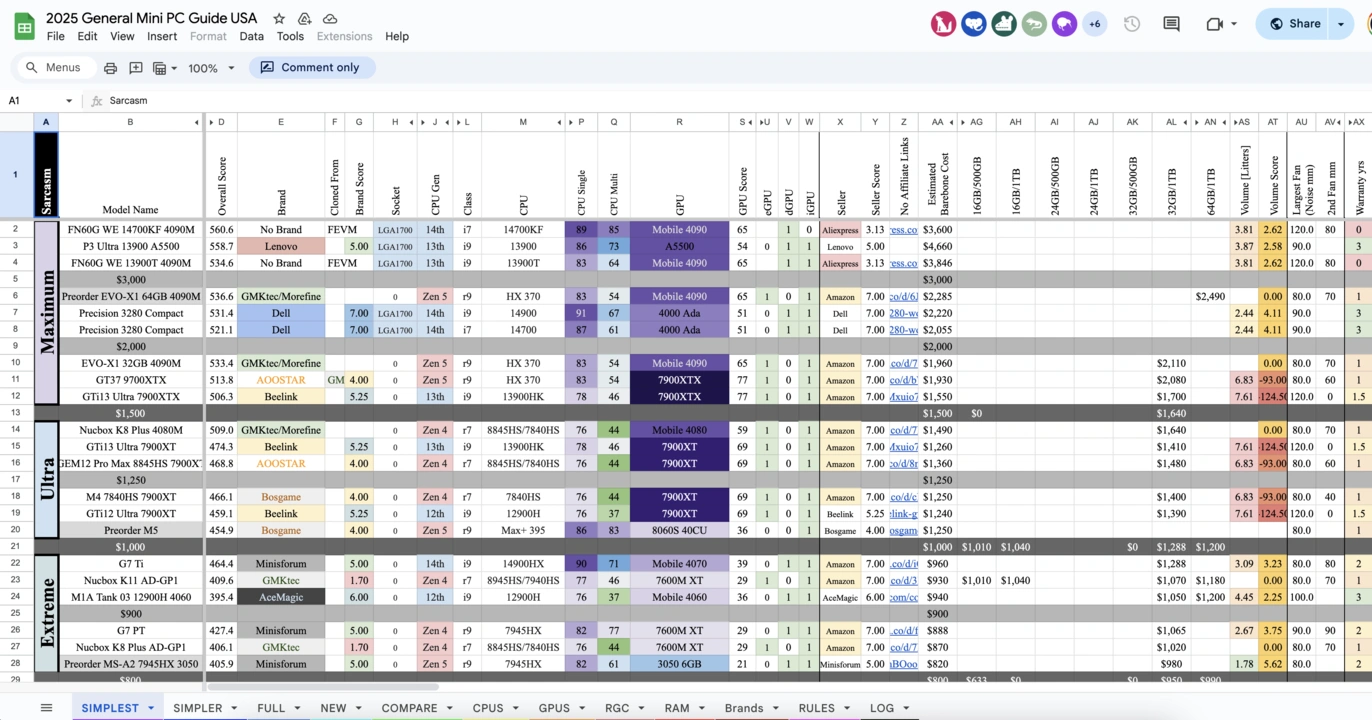
If you have only a passing understanding of the mini PC landscape, we highly recommend checking out this spreadsheet that catalogs the 2025 US mini PC market. This heroic effort by Redditor u/SerMumble lists over a thousand small form factor computers.
Granted, that number includes outliers such as eGPU docks and gaming handhelds, along with past iterations that are still on sale. But even the simplest version of the guide, which has only top recommendations and blacklists, still leaves us with more than 60 models to compare. Like traditional desktop computers, mini PCs are powered by a wide range of CPUs and APUs, from efficient chips such as the Intel N100 to the aforementioned Ryzen AI series. But many models within each performance tier differ only in small ways, such as RAM configuration, built-in storage capacity, or I/O selection.
Proprietary implementations
The aforementioned spreadsheet lists 13 major mini PC vendors, each with their own board and case designs. This is a daunting landscape for those expecting long-term support and realistic repair options. The risk has already materialized for customers of Intel’s NUC series, which the chip giant abruptly abandoned in 2023.
The NUC brand lives on under ASUS. However, the company is currently prioritizing pre-built systems, as opposed to Intel’s promotion of both kits and standalone boards for its SKUs. This may be understandable given that ASUS is catering to a general audience, but it is also clear that NUC’s identity has fundamentally changed.
Non-standardized form factor
Despite the form factor’s distinctive name, there is no recognized standard at its foundation. While many manufacturers follow the 4” x 4” NUC motherboard size, numerous custom designs exist, particularly for more powerful components requiring advanced cooling.
This fragmentation prevents the mini PC from having a healthier ecosystem of accessories as well as spare parts, and ultimately prevents repair and component reuse.
How OpenSFF can simplify Mini PCs
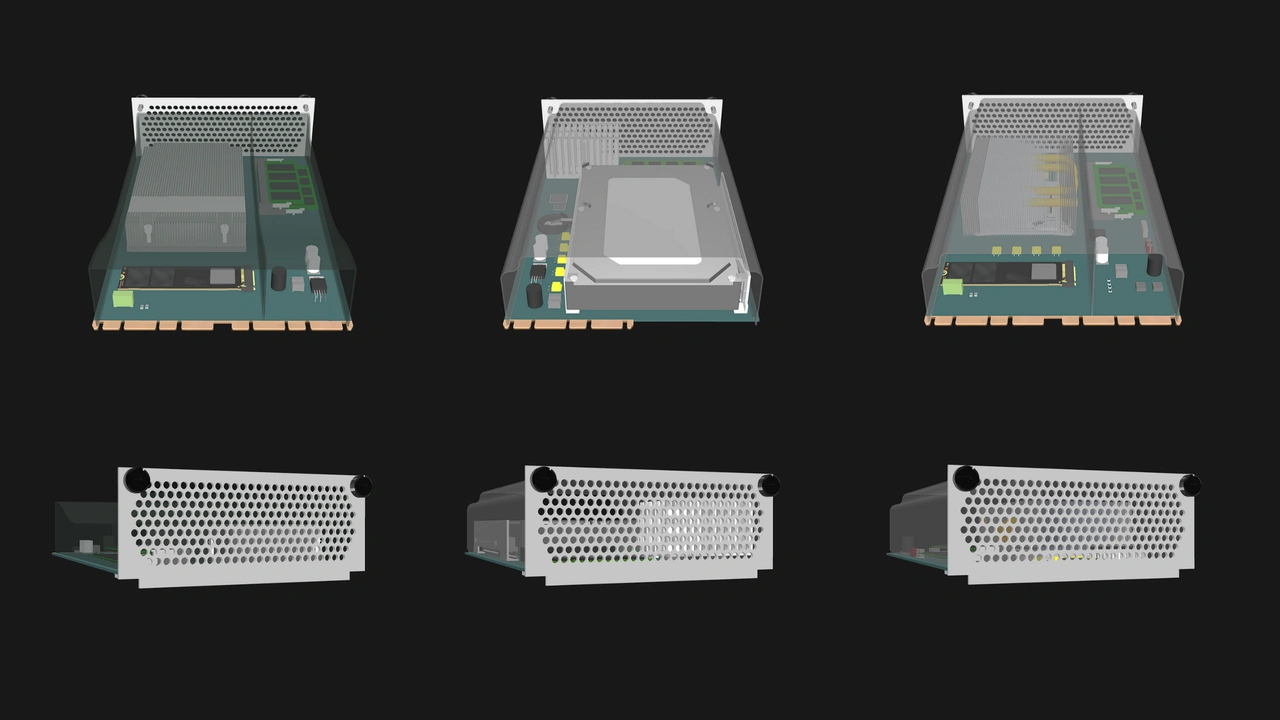
Our specifications address the fragmentation of mini PCs by requiring modular and standardized components that separate compute performance from form factor and connectivity.
Streamlined product lines
Instead of researching hundreds of pre-builts with overlapping specifications, users should be able to choose from only a dozen or so Compute Nodes based on their desired performance. They can then pair the node with an Enclosure that provides the form factor, connectivity, and power that they require.
For instance, the AMD Ryzen 7 7840HS is a popular and well-received upper mid-range APU. A quick search on the 2025 US mini PC spreadsheet for systems equipped with the 7840HS yields a staggering 182 systems. Even if we generously cut that figure in half to exclude less relevant results such as handhelds and eGPU docks, that is still nearly a hundred models to dive into and compare.
With OpenSFF, that same search is distilled to only a handful of Compute Nodes and Enclosures. When our standard becomes widely adopted, the options for Compute Nodes and Enclosures may grow. But the modularity of these components will help customers remain flexible in choosing the combination that fits their needs, both before and after their initial purchase.
Modularity
OpenSFF’s modular standard gives customers flexibility when upgrading or replacing components. Compute Nodes and Enclosures can be swapped independently. One can swap the Compute Node while keeping their Enclosure, or vice-versa to seamlessly transform their system. A customer can even keep multiple Enclosures at once and use the same Compute Node for all of them, switching according to their use case or for testing.
Serviceability
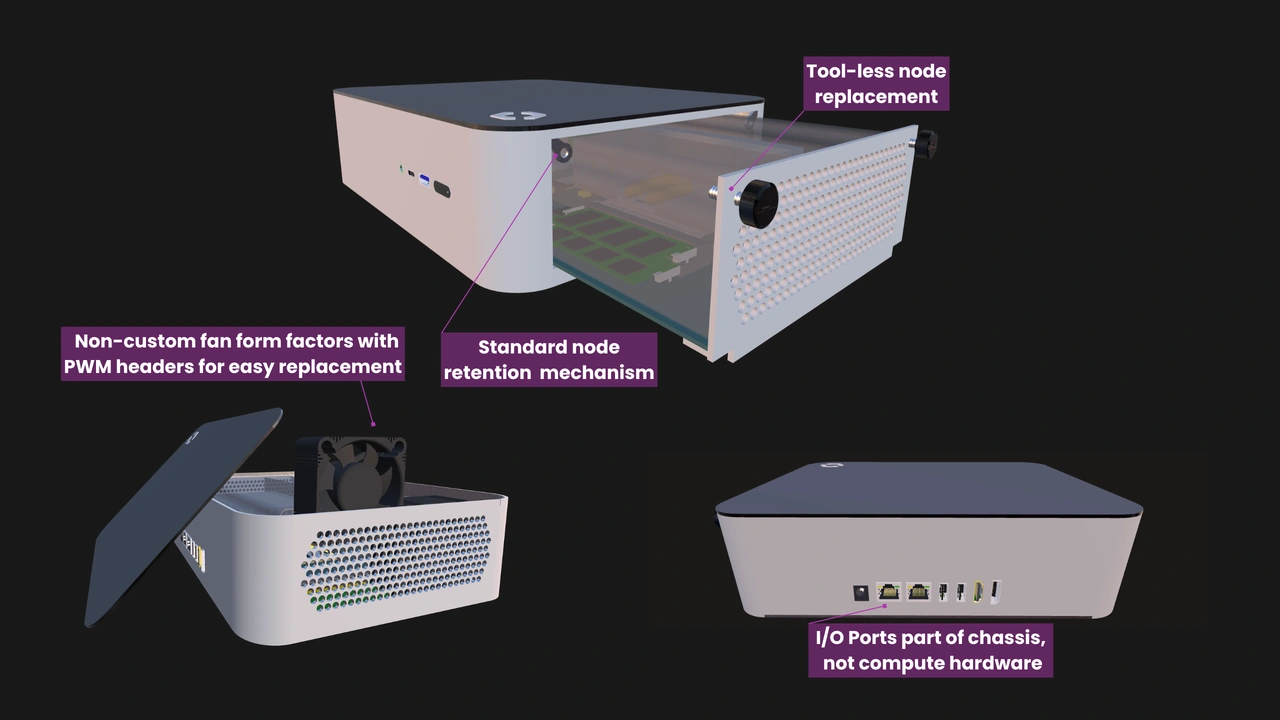
Toolless Compute Node access is built into OpenSFF specifications, making repairs and upgrades easier for all customers, from non-technical users to field technicians.
Standardized thermal characteristics
OpenSFF defines specific airflow requirements to ensure consistent thermal performance across all compatible systems. Customers will be able to purchase a Compute Node from any vendor and pair it with an Enclosure from any vendor, assured that the resulting system will have minimal heat and noise output.
Benefits
For end users
- Simplifies purchases and upgrades
- Creates an ecosystem where serviceability is a given, not a luxury or a warranty-voiding endeavor
- Helps ensure that components will serve multiple life cycles
For enthusiasts and homelabbers
- Home servers can comprise Compute Nodes from different vendors and different CPU architectures within the same Enclosure
- Consistent interfaces simplify troubleshooting and reduce reliance on vendor-specific documentation and support
- Enclosures with multiple Compute Node bays (and optionally, internal switches) reduce clutter and points of failure, as opposed to fitting multiple mini PCs that each have their own chassis into a single cabinet
- Enclosures with shared power eliminate guesswork about power delivery
- Streamlined knowledge sharing and recommendations, particularly to non-technical peers
For businesses
- Simplifies procurement by allowing IT teams to standardize on one or a few Compute Node configurations for diverse deployment scenarios
- Enables standardized maintenance workflows, reducing training requirements and operational complexity
- Cost optimization and environmental sustainability through modular upgrades
For vendors and system integrators
- Shared ecosystem expands addressable market, including the surging edge computing sector
- Opportunity to simplify product lines and focus on genuine differentiators
- Shorter design and testing cycles due to standardized interfaces
Simplify with OpenSFF
We love mini PCs and we love having options. But this industry is at a critical juncture. We believe that embracing standardization enables sustainable growth and empowers users, while further fragmentation ultimately limits adoption and innovation.
We encourage you to read our specifications, and we would be grateful if you help spread the word about OpenSFF. For technical clarifications, partnerships, and other inquiries, reach out to our development team at [email protected].
Other Articles

Meet OpenSFF: an open hardware standard that enables cross-vendor compatibility, modular systems, and sustainable hardware reuse.
August 11, 2025
We go over the rise of virtualization and the open software adopted by home server enthusiasts, as well as the current challenges and the future of the hobby.
September 06, 2025

Learn why OpenSFF adopted the SFF-TA-1002 connector standard and how it enables our vision.
September 18, 2025