Blog
Long Term Commit: The Open Tools We Love
Introduction
We’re hard at work on our humble contribution to the open source movement, but we’re putting on our user hats for this article. There are thousands of amazing and fascinating open source projects out there. We’ve been toying with the idea of a regular series where we showcase these wonders, such as 9001’s tiny yet powerful copyparty, sam-astro’s mind-link, and of course pystardust’s ani-cli.
But this article isn’t about shiny new things or endless possibilities. Or anime. This is our love letter to the tools we use, regardless if they’re well-known or modest. They’re part of our lives, they serve us well, and we can’t thank their creators enough for making and sharing them.
Adafruit PCB Ruler v2
OpenSFF specification developer Jon Choi tells us that this gold-plated beauty is “the hardware designer’s favorite ruler.” No wonder it's out of stock as of this writing. Component packages are densely yet neatly arranged on its body, along with a couple of useful guides.
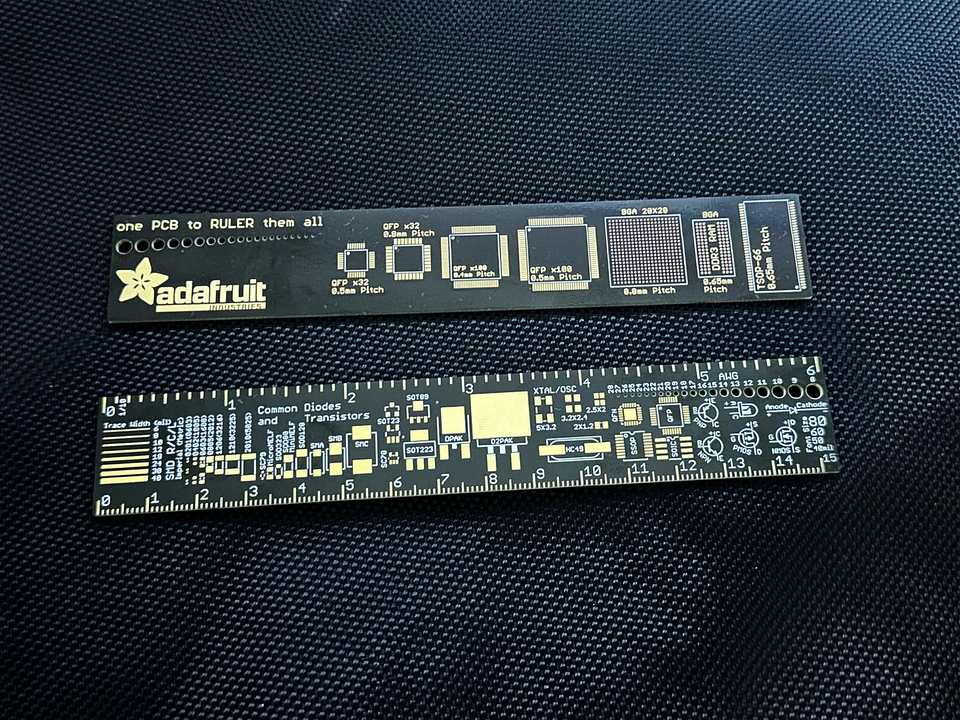
Jon finds it handy for drawing PCB layouts and approximating if components fit. But it comes in clutch even when he's not on his workbench: “The wire gauge holes are seriously useful for regular electrical or electronics repairs at home.”
TL611-PRO debug card
We just got started and we’re already forking our list. Our internal systems lead Paulo Agojo knows that this motherboard diagnostic tool isn’t open source. But it embodies transparency over lock-in, and that counts for something.
Paulo uses it to diagnose and repair motherboards, “whether it's the 3VSB, DRAM, and many more.” As Jon points out, the TL611-PRO interfaces transparently with the motherboard, instead of through a proprietary operating system. In an ideal world, you shouldn’t need a vendor’s tool or blessing to fix your own hardware. This debug card lets repair advocates like Paulo reclaim a bit of that promised land.
WireGuard
Paulo’s second pick is WireGuard, the go-to VPN protocol for many homelabbers. Paulo explains, “It’s my own self-hosted VPN, and I can even access my own network through it just by adding devices as peers and generating their own keys. I have a homelab, so I technically use this software 24/7 to expose a public port.”
If the TL611-PRO gives Paulo a chance to take control of his hardware, WireGuard truly gives him control of his network.
Proxmox VE
Next on our list is another homelab heavyweight. Our network engineer Dave Timbol admits that this virtualization environment has a steep learning curve, but it’s been an enjoyable and rewarding experience for him.
Dave is especially grateful for the fact that Proxmox VE is packed with features despite being completely free. He can automate deployments, configure drives in a number of ways, use containers and Linux KVM, and manage his virtual machines easily through its GUI.
Excalidraw
Our Rust backend developer Martin Atole sends his love to the team behind Excalidraw, the open source virtual whiteboard: “I use Excalidraw to quickly sketch and visualize ideas, especially when explaining technical topics to clients or teammates. Instead of long explanations, I can draw flows and concepts in real time, which makes discussions much clearer. What I really appreciate about it is how fast and simple it is to use, it helps me express ideas quickly and turn complex concepts into visuals that are easy to understand.”

Like a battle-hardened knight, Excalidraw wastes no motion. You just load the site and start drawing. No log in, no dashboard, no fluff. Just an infinite canvas with a toolbar of essential functions.
Obsidian (plus Syncthing and Tailscale)
This superb Markdown tool is one of those projects with a rapidly growing and passionate fan base. It’s no surprise that two of our teammates chimed in to express their gratitude to the second brain known as Obsidian. Our Linux developer Renzo Cabarios moved his notes from a paid Notion account to Obsidian. He particularly loves its mind-mapping option: “Makes you realize all of the information you know are somewhat interconnected. I also use it like a journal. When I learn something new, I put down my insights and sample scenarios in Obsidian.”
Obsidian has also been the trusty archivist of our hardware engineer and software developer Carlo Jones. Inspired by the work of developer Sebastian Lague, Carlo’s been documenting resources and his insights on how computers work on a fundamental level.
While it's free to use, syncing notes across devices directly within Obsidian requires a paid subscription. So Carlo’s been self-hosting his notes with the help of two other open source titans: the file synchronization program Syncthing and the zero-config mesh VPN Tailscale.
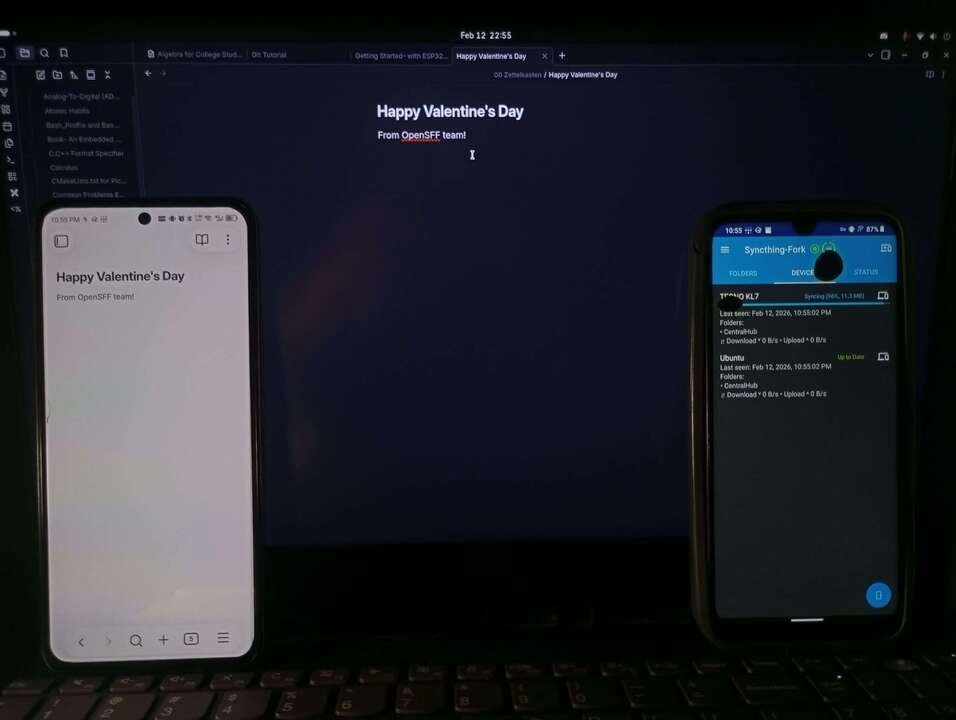
Inspired by Arthav Munot’s private cloud setup, Carlo takes down notes in Obsidian and syncs them via Syncthing to an old smartphone that he turned into a storage device. Routing his setup through Tailscale then lets him access his notes from anywhere in the world.
LocalSend
Our last pick is from yours truly, the technical content writer here at OpenSFF (I’ve been here the whole time!). LocalSend is a cross-platform file sharing tool. We’ve used it to send and receive travel photos to and from iOS and Android devices, and transfer documents from our phone to our laptop, freeing us from the email-to-myself millennial pipeline.
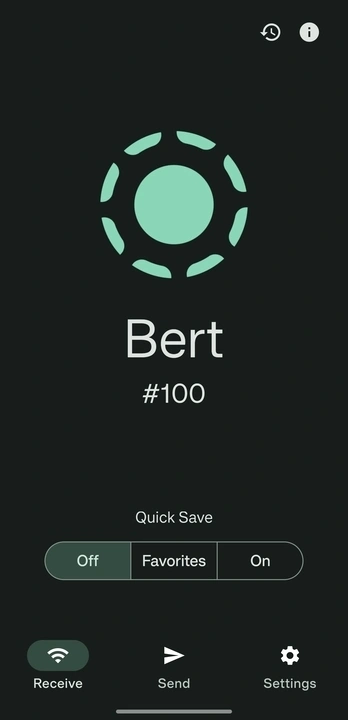
Sure, AirDrop and Quick Share are more convenient on the go. We’ve had to set up a personal hotspot on a third device a couple of times to use LocalSend. But we’d gladly take that tradeoff for a platform-agnostic, account-free, and dead simple process.
Conclusion
To the crafty and generous people behind these tools: merge request? 🤗
We’re truly grateful for all your hard work and for sharing your wonderful creations with us. We hope that one day, OpenSFF will be on someone’s list of favorite open source creations as well.
If you’d like to know more about our specifications or are interested in building (non-romantic) partnerships, reach out to our development team at [email protected].
Other Articles

Meet OpenSFF: an open hardware standard that enables cross-vendor compatibility, modular systems, and sustainable hardware reuse.
August 11, 2025
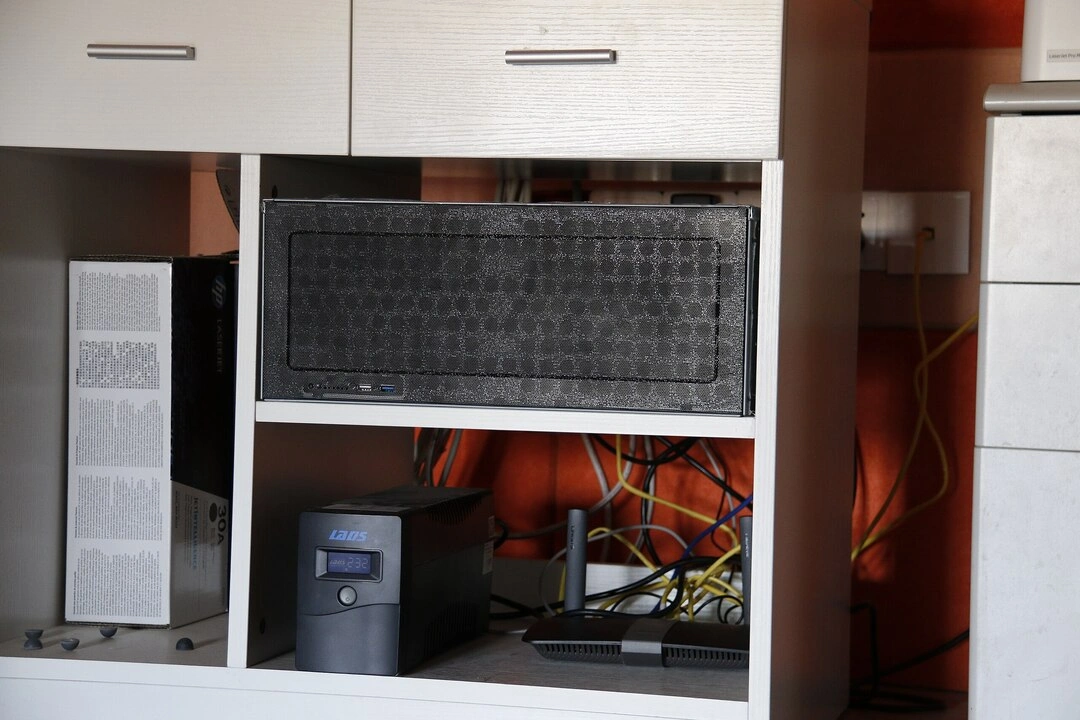
We go over the rise of virtualization and the open software adopted by home server enthusiasts, as well as the current challenges and the future of the hobby.
September 06, 2025

Learn why OpenSFF adopted the SFF-TA-1002 connector standard and how it enables our vision.
September 18, 2025